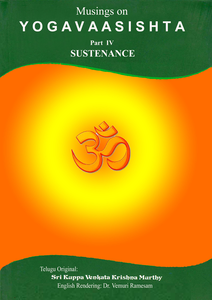
Serialization of Yogavasishta 5

Professor Sri Kuppa Venkata Krishna Murthy, Chairman and Managing Trustee of I-SERVE, the Institute of Scientific Research on Vedas, has kindly given permission for Advaita Vision to serialize his 6-volume ‘Musings on Yogavasishta’. Written in Telugu, the work has been painstakingly translated by our Dr. Ramesam Vemuri and published by Avadhoota Datta Peetham.

Rather than reproducing successive extracts from the books each month, as has been done with our other two serializations, the books themselves will be made available for download in PDF format. Each part will be associated with a page at the main website, which will contain a Contents List for that volume. Links to all of the volumes will be provided on a general Contents Page.

The present volume, “Musings on Yogavaasishta” – Part IV Sustenance, is a presentation by Brahmasri Kuppa Venkata Krishna Murthy, the Vidyadhikari of Avadhoota Datta Peetham, Mysore and Chairman, Institute of Scientific Research on Vedas (I-SERVE) and forms a part of his lectures on “Yogavaasishta” telecast by GEMINI T.V. in Telugu. This volume is a rendering of the same into English by Dr. Vemuri Ramesam. In it: The 3000 stanzas of the fourth chapter on Sustenance (Stithi) have been ably condensed and lucidly explained in simple words. Possible methods of alleviation from the state of Bondage and annulment of mind are described through the stories of Bhargava, Daama, Vyaala, Kata, Daasura, and others.

Please go to the Contents Page to read the Announcement and general introduction from Ramesam. The page for this Fourth Volume, Part 4 (SUSTENANCE) also contains the download link for the PDF file (0.6MB).

Q.384 – Dark night of the soul

Q: Please help me.I had a temporary glimpse of reality around 15 months ago by following 8 fold path. I tried to penetrate the question of suffering and learned that everything wants to come into Equilibrium (a known chemistry fact) due to which my thought trains stopped and I got an instant realization of something called reality. After that, I experienced I am a silent witness and not mind, body, ego, etc.

This faded away after some time and now I am in mental anguish and turmoil. I don’t know what is happening in my mind but it is disturbed or in what people call the “Dark night of soul”. Every joy is lost now; I get angry easily and have feelings of despair from something. Maybe it is because I didn’t discipline my mind with ethics before starting this practice for enlightenment. Please save me now. Whatever is going on in my head, save me from it. I don’t know how to complete surrender unto reality and may be this is due to the hold of ego. Please help!

A (Dennis): The teaching tradition of Advaita is all about Self-knowledge. You listen to the teaching from a qualified teacher (ideally) or read about it and discuss it (less good). You ask questions about it to resolve your doubts. Eventually, you realize that what is being said is true and that is that. In theory!

The problem is that you need a clear, self-controlled mind and some trust in the teacher, the ability to discriminate and so on. These ‘skills’ are not really a part of Advaita – they are mostly lifted from Patanjali’s Yoga system. If you have no mental discipline along these lines, you are never going to be able to assimilate the teaching. You need at least a medium level of attainment. With that you can take on board the knowledge and then continue your practices until you reap all the other benefits (peace of mind, fearlessness and so on).

From what you say, I would advise that you forget about Self-knowledge for a while and concentrate on acquiring the mental skills. Meditation is invaluable. And, if you have no religious-type outlook (praying to a god and so on), then the practices of karma yoga are the other main route – doing what is in front of you because it needs doing, ignoring desires and not expecting any results. And so on!

I do not know anything about Buddhist methods so cannot really comment. I would forget about ‘dark nights’. The main thing to remember, even if you don’t yet believe it, is that the world is not absolutely real. Your body, mind and everything else have empirical reality only, depending ultimately on Consciousness, which is the only reality. And you are That.

Free Will versus Fatalism


Below is another essay from Atman Nityananda whose earlier essay on sAdhana triggered so much interest. This is preceded by an essay on the same topic from Swami Sivananda.


Free Will versus Fatalism
by Swami Sivananda

The controversy between free will and fatalism is still going on in the West and no one has come to any definite conclusion. It is a great pity that the doctrine of Karma is mistaken for fatalism. Fatalism is the doctrine that all events are subject to fate and happen by unavoidable necessity.

Fate is otherwise known as luck or fortune. That indefinable mysterious something which brings trials, successes and failures to man, which shapes and moulds him by teaching lessons of various sort, which takes care of him like a mother, which brings various sort of experiences, which brings cloudy days and days of bright sunshine, which raises a beggar to the level of a landlord and hurls down a mighty potentate to the level of a street-beggar, which gives different kinds of fruits and experiences to two people of equal talents and capacities, which made Napoleon at one time a terror in the eyes of the people and at another time a prisoner, and which makes a certain portion of the life of a man quite stormy and another portion quite smooth, is called fate. Fate educates and instructs man. However whimsical the fate may appear to operate, it works in harmony with the law of causation. Continue reading

Vedanta the Solution – Part 27

venugopal_vedanta

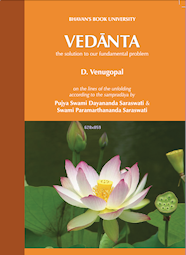
VEDĀNTA the solution to our fundamental problem by D. Venugopal

Part 27 begins the enquiry into the nature of the jIva. It looks at the various explanations for how Consciousness manifests in the body-mind and the special role of the buddhi.

There is a complete Contents List, to which links are added as each new part appears.

Tattvabodha – Part 12

OLYMPUS DIGITAL CAMERA

Part 12 of the commentary by Dr. VIshnu Bapat on Shankara’s Tattvabodha.This is a key work which introduces all of the key concepts of Advaita in a systematic manner.

The commentary is based upon those by several other authors, together with the audio lectures of Swami Paramarthananda. It includes word-by-word breakdown of the Sanskrit shloka-s so should be of interest to everyone, from complete beginners to advanced students.

Part 12 examines the waking and dream states of experience.

There is a hyperlinked Contents List, which is updated as each new part is published.

The Mystery – Part 2

bimal_cover

Continuing this new, short series presenting the booklet by Bimal Prasad, in which he answers some ‘Rarely Asked Questions’ on Life. Primarily from the perspective of Advaita, questions addressed include the nature of happiness, consciousness, mind and ego. There is also practical guidance on meditation in the final chapter. Answers are relevant and succinct, so that many of the issues of interest to the seeker are covered.

This second part looks at the distinction between ‘I’ and the body-mind and identifes ‘Consciousness’ as being who we really are. See the Contents List or go straight to Part 2 of the series.

The complete (electronic form) booklet may also be purchased from Amazon.

Vedanta the Solution – Part 26

venugopal_vedanta

VEDĀNTA the solution to our fundamental problem by D. Venugopal

Part 26 examines the nature of AtmA, utilising the ‘descriptions’ from the Brihadaranyaka, Kena and Mandukya Upanishads. How can we ‘know’ the Self, when it is not an object?

There is a complete Contents List, to which links are added as each new part appears.

The Mystery – Part 1

bimal_coverA new, short series presenting the booklet by Bimal Prasad, in which he answers some ‘Rarely Asked Questions’ on Life. Primarily from the perspective of Advaita, questions addressed include the nature of happiness, consciousness, mind and ego. There is also practical guidance on meditation in the final chapter. Answers are relevant and succinct, so that many of the issues of interest to the seeker are covered.

See the Contents List or go straight to Part 1 of the series.

The complete (electronic form) booklet may also be purchased from Amazon.

Reflections on Body-Mind and Liberation

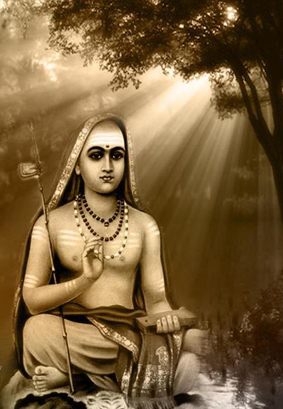
shankaraThere has been much healthy debate recently on the Advaita Vision Blog about Liberation, who or what is a jnani or jivanmukta, and what it means to follow traditional Advaita. The theme of this post is that we cannot resolve such questions without first gaining a clear understanding of the body-mind and its role in the context of Liberation. What follows are some reflections inspired by a spirited discussion with Ramesam, with due credit to him for stimulating many of the thoughts below. Any errors or possible misunderstandings are entirely my fault. Or perhaps not, since “Words fall back from it.” Continue reading

‘ego’, self, and metaphysics – Part lV

In the Buddhist perspective, the ego or self as ordinarily considered in Western traditions (i.e., as soul or person), is a non-self, actually a non-entity (anatta). Hence the suffering, which stems from an experience -ultimately illusory- of separation and vulnerability.

Here we have to consider two things. First, according to Mahayana Buddhism, Adi-Buddha, equivalent to Dharmakaya – the highest metaphysical, or divine, level – represents that unique Being or Divine ‘State’, pervading all manifestation as Buddha-nature; and second, the notion of the Self (Atman, derived from the Hindu Vedanta) is not only compatible with that view, but also with that of the Spirit in Christianity and in Islam.

As to the soul (metaphysics and theology), though intrinsically perfect or whole in itself (one could add: in ‘primordial man’ –the purusha or Hiranyagarbha of Hinduism)- it experiences imperfection, self-limitation, anxiety and doubt in its state of (aparent) separation -the ‘fallen state’. Being, not just potentially, a ‘focal point of the Universe’, yet it becomes, through ignorance and self-will, the subject of illusions, attachments, and passions which lead to that predicament. Its condition is thus ambivalent; it can orient itself upwards (or towards the centre) – to ‘holiness’ and integration – or downwards, pulled by its ‘lower nature’ (nafs in its lower stages, according to Sufism). The end result will be either self-denial, or self-assertion; self-giving, or ego-centeredness. Inevitably, this latter tendency, based on ignorance, can only lead to an unwanted result: dispersal, disintegration, and suffering. Alas!, on the whole, if not in principle, psychiatry is not interested in this distinction or dichotomy; but let not anything else be said about this at this point.

From the viewpoint of advaita vedanta, all of what is described in this paragraph – and what follows – pertains to the empirical, relative (ontological and epistemological) level: mithya (or vyavahara), in other words. Continue reading