Who (or what) is it that ‘acts’?

Those who have read any of my books, or the brief biography that is available on this site and others, will know that I began my ‘philosophical investigations’ with the School of Economic Science, as it is known in the UK. And you will also know that I have commented frequently upon the misguided notions that were propagated by the school in the name of Advaita. One of the key misunderstandings that I had, which was not cleared for many years, despite reading widely and discussing Advaita with many people on the Internet, relates to ‘action’.

As usual, this was a Sankhyan idea effectively being passed off as belonging to Advaita. It was the notion that it is ‘the guNa that act’, or that action is a function of prakRRiti. In the first edition of ‘The Book Of One’, I actually had a chapter called ‘The Myth of Action’ and the first section of this was entitled ‘Only the guNa Act’. Here are several paragraphs from this:

 “The three qualities of nature, the guna, of which all of nature is constituted, are in constant motion and this is the only ‘action’. Yes, the body acts – it is constituted of the three guna – but we do not. Here is a useful practical example of this: It may be that you cycle from time to time. I enjoy cycling in the New Forest, where I live – free exercise in beautiful surroundings and fresh air. However, there are a few hills along the routes, and sometimes you have to go up these rather than down. Many people just get off and walk their cycle up. Others take it as some sort of challenge and insist on trying to cycle to the top without having to dismount. When the going becomes hard, they make an extra mental effort, along the lines of ‘I am damn well going to get to the top, even if it kills me’! This is the hard way! Continue reading

Q. 391 – Dissociation

Q: Does the psychological concept of dissociation have any role in advaita? In other words, the subjective experience of being detached, depersonalized, or wholly uninvolved in any given situation–is this the same as what advaita might call “awareness” or “just happening?” If not, how are they actually different?

A (Dennis): Who-we-really-are is not the mind; we are the Consciousness in which the mind arises. However, it is the mind of the person that realizes this in what is termed ‘enlightenment’ or (better) Self-knowledge. A mind that is not balanced and controlled/disciplined is most unlikely ever to be able to attain this Self-knowledge; it will be more interested in avoiding fear, satisfying desires etc. A mind that is unbalanced/disturbed etc is even less likely to be capable of assimilating the teaching of Advaita. As far as I understand the term ‘dissociation’, it refers to just such a mind – one in which the functions of the mind are out of balance, with some parts functioning normally and some not at all. So, no, it is not the same.

Good question, though!

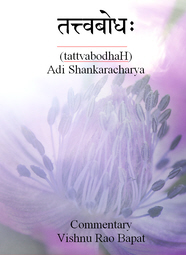
Tattvabodha – Part 19

Part 19 of the commentary by Dr. VIshnu Bapat on Shankara’s Tattvabodha.This is a key work which introduces all of the key concepts of Advaita in a systematic manner.

The commentary is based upon those by several other authors, together with the audio lectures of Swami Paramarthananda. It includes word-by-word breakdown of the Sanskrit shloka-s so should be of interest to everyone, from complete beginners to advanced students.

Part 19 looks at the traditional description of the formation of the mental aspects from the sattvika qualities of the five elements and the formation of the organs of action from the rajasika aspects.

There is a hyperlinked Contents List, which is updated as each new part is published.

Is Consciousness Entirely Physical?

I off and on referred in these columns to the exciting new Theory of Integrated Information developed by Porf. Giulio Tononi of Wisconsin to explain Consciousness (For example here and here).  We have Dr. Tononi explaining the basic concepts behind the theory in simple words in the short Videos at the following links:

  1.  Is Consciousness entirely physical? (8:12 min)
  2.  Anything non-physical with the mind? (9:27 min)

A few other very interesting topics related to Consciousness are also discussed in this series of Videos hosted by Dr. R.L. Kuhn.

Overview of Western Philosophy – Part 7

(Read Part 6 of the series.)

The Mind-Body Problem

Descartes’ separation of man into the two aspects of mind and matter also became the principal way in which Westerners subsequently viewed the world. Matter is extended in space, can be divided and so on, while mind is indivisible and seems to exist separate from the body, somehow outside of space. This is the theory known as Cartesian Dualism. Unfortunately, he was never able to explain how such completely different ‘substances’ were able to interact. The idea of an immaterial ‘little me’ somehow sitting in the brain (Descartes thought the soul resided in the pineal gland) and interpreting the information transmitted from the eyes and other material senses just did not make sense. How could this interface work? The so-called ‘mind-body problem’ has intrigued philosophers ever since and no universally accepted model of the nature of the self has yet emerged.

One of his disciples, a Dutchman called Arnold Geulincx, suggested that the mind and body were separately governed by God, who kept the two in synchronisation, like clocks. Thus, when we decide to do something and it happens, such as getting out of bed, there is no actual interaction between the two, no ‘willing’ as such, it is simply the consequence of the two being synchronised. A similar theory, called Occasionalism, was proposed by the French priest, Nicolas Malebranche. He said that neither mental nor physical events cause other events. Instead, what we call a cause is simply the occasion for God to exercise his will and instigate what we call the effect; there is no actual connection between the two events at all. All of this meant that life is strictly deterministic, with no place for free will and everything happening according to physical (or divine) law. Continue reading

Consciousness and neuro-science

Discussion from Quora

(Different from above) Prof. Donald Hoffman – The Case Against Reality .

A professor of cognitive science argues that the world is nothing like the one we experience through our senses.

Evolution has shaped us with perceptions that allow us to survive. They guide adaptive behaviors. But part of that involves hiding from us the stuff we don’t need to know. And that’s pretty much all of reality, whatever reality might be.

Snakes and trains, like the particles of physics, have no objective, observer-independent features

Gefter: I suspect they’re reacting to things like Roger Penrose and Stuart Hameroff’s model, where you still have a physical brain, it’s still sitting in space, but supposedly it’s performing some quantum feat. In contrast, you’re saying, “Look, quantum mechanics is telling us that we have to question the very notions of ‘physical things’ sitting in ‘space.’” Continue reading

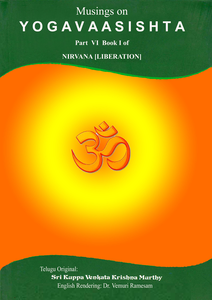
Serialization of Yogavasishta 7

Professor Sri Kuppa Venkata Krishna Murthy, Chairman and Managing Trustee of I-SERVE, the Institute of Scientific Research on Vedas, has kindly given permission for Advaita Vision to serialize his 6-volume ‘Musings on Yogavasishta’. Written in Telugu, the work has been painstakingly translated by our Dr. Ramesam Vemuri and published by Avadhoota Datta Peetham.

Rather than reproducing successive extracts from the books each month, as has been done with our other two serializations, the books themselves will be made available for download in PDF format. Each part will be associated with a page at the main website, which will contain a Contents List for that volume. Links to all of the volumes will be provided on a general Contents Page.

The present volume, “Musings on Yogavaasishta” – Part VI (Nirvana – Liberation, Book-I), is a presentation by Brahmasri Kuppa Venkata Krishna Murthy, the Vidyadhikari of Avadhoota Datta Peetham, Mysore and forms a part of his lectures on “Yogavaasishta” telecast by GEMINI T.V. in Telugu. This volume is a rendering of the same into English by Dr. Vemuri Ramesam. In it: The 5000 stanzas of the sixth chapter on Liberation
(Nirvana Book I) have been ably condensed and lucidly explained in simple words. Possible methods of alleviation from the state of Bondage and annulment of mind are described through the stories of Bhushunda and others.

Please go to the Contents Page to read the Announcement and general introduction from Ramesam. The page for this Sixth Volume, Part 6 (NIRVANA – LIBERATION Book 1) also contains the download link for the PDF file (1.2MB).

This is the Final Part of the series. Our thanks again to Professor Sri Kuppa Venkata Krishna Murthy and Dr. Vemuri Ramesam for their generous gift.

Birth and Death

One of the most startling passages that I encountered when I first began to study advaita was that in chapter 2 of the Bhagavad-Gita in which Arjuna bemoans the fact that he is expected to kill his teachers and relatives. Krishna responds with the following amazing statement (II.19 – II.20): “He who thinks that the spirit kills, and he who thinks of it is killed, are both ignorant. The spirit kills not, nor is it killed. It was not born; it will never die: nor once having been, can it ever cease to be: unborn, eternal, ever enduring, yet most ancient, the spirit dies not when the body is dead.” (Ref. 1)

Needless to say, the idea of death is one that disturbs most people. Indeed, it is probably the most feared event for the vast majority whether or not they believe that it signifies the literal end of their existence. Life appears to have the profile of a hill. We start at the bottom; slowly we begin to make an impression on life, ‘making a name for ourselves’, acquiring all of those things that are considered to make life significant – job, spouse, peer recognition, house and money etc. And then, there comes a time when we feel that we have achieved all that we are going to achieve. Ambitions cease; physical and mental capabilities decrease; ailments become more frequent; there is a gradual slide into physical decay and ultimate death. As Macbeth puts it so depressingly:

Life’s but a walking shadow, a poor player
That struts and frets his hour upon the stage
And then is heard no more.

Or, as Jaques puts it in ‘As You Like It’:

Last scene of all,
That ends this strange eventful history,
Is second childishness and mere oblivion,
Sans teeth, sans eyes, sans taste, sans everything.
Continue reading

Vedanta the Solution – Part 30

VEDĀNTA the solution to our fundamental problem by D. Venugopal

Part30 concludes the discussion on the ‘description’ of brahman as satyam j~nAnam anantam and then looks specifically at the meaning of ‘existence’ (sat) with reference to the body-mind-sense-complex.

There is a complete Contents List, to which links are added as each new part appears.

The Mystery – Part 5

Continuing this new, short series presenting the booklet by Bimal Prasad, in which he answers some ‘Rarely Asked Questions’ on Life. Primarily from the perspective of Advaita, questions addressed include the nature of happiness, consciousness, mind and ego. There is also practical guidance on meditation in the final chapter. Answers are relevant and succinct, so that many of the issues of interest to the seeker are covered.

This fifth part looks at how we can be ‘in the present’ and at how the mind functions. See the Contents List or go straight to Part 5 of the series.

The complete (electronic form) booklet may also be purchased from Amazon.