How Many Universes?

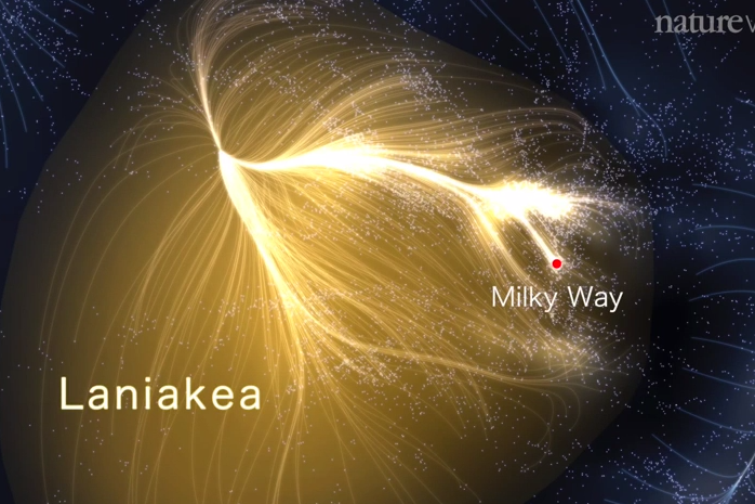
Multiverse - Nature - Sept 2014 I wrote a Blog Post with the title “How Many Universes Make A Multiverse – The Story of Bhetala” inspired by a story narrated by Sage Vasishta in the first part of the Sixth Chapter: Nirvana in Yogavasishta. The Link to the Post dated Nov 4, 2009 is here. The metaphor described was as follows:


“Think of the universe that we are all living in to be a humongous fruit.

There is a bough with thousands of those fruits.
There is a tree with thousands of such boughs.
There is a wood with thousands of such trees.
There is a mountain with thousands of such woods.
There is an island with thousands of such mountains.
There is a huge globe (mahi peetha) with thousands of such islands.
There is a huge star system with thousands of such globes.
There is a heavenly egg with thousands of such star systems.
There is a sea with thousands of such heavenly eggs.
There is an ocean with thousands of such seas.
Thousands of such oceans will be the waters in the stomach of a man.
That man’s name is Vishnu. Continue reading

Dream Space, Awake Space and Mind-Space

[This short extract, in addition to providing the answers, also serves as an example of the incisive logic and inductive and deductive approach taken by Sage Vasishta in explicating the nature of the world to Rama in the well-known Advaitic scripture, Yogavasishta. The present material is from Chapter 2: mumukshu vyavahAra prakaraNa (The Conduct and Behavior of a committed Seeker), Original text: Shri K. V. Krishna Murthy; English translation: Ramesam Vemuri]

Where do the brahmANDa-s (multiverses) of the present time exist? They are in space.  What is space exactly?

One definition for space is that because of which it is possible for two objects to exist separated from one another.  We can also define it in another way. Space is that in which all the known objects are located.  But your dream world is also known to you! Can you say where do the rivers, mountains and all the other things of your dream world are located in the present awake world space?  Continue reading

Questions by Peregrinus

[Reference: https://www.advaita-vision.org/life-is-a-dream-the-world-is-real/#comment-3266 ]

Gary Crowley 2006Dear PtN,

Great Questions!

In providing answers to those very  questions, volumes have been written, several concepts have been floated and related downstream issues have been under constant debate from several centuries (if not millennia) ago up to even now . The positions taken are so extreme and contradictory to each other that protagonists of different propositions do not see eye to eye.  Unable to wrap their minds around the Advaita concepts and unconvinced by the Advaita models, some people (Tatva vadins – followers of the 13th century Madhvacharya) ascribe as much reality to the individual as to brahman but deny the identity of the two. The fights between them and the Advaitins are legendary. And there are notorious disagreements even within the Advaitins also on subtle details of the theories they propose as answers. Hence it is quite safe to say at the outset that there are no straight answers to any of these fundamental questions, as you may be already knowing from your voracious reading. Hence, switching on all caveats and disclaimers …… …… ……, I stick my neck out. Continue reading

Knowledge, Action and Liberation – AV


title figure 1When Ed Witten, the legendary genius Physicist of Princeton, proposed his theory integrating the four or five disparate string theories during the mid-nineties, he called it the M-theory. He did not specify what exactly M stood for.  So Science Communicators went wild with their own interpretations. Some said M is for Mother to say it is the mother of all theories. Others said M is for Meta. Still others said M is for Membrane or Matrix. Some even suggested M is for Mystery or  Magic.

I leave it to the imagination of the reader what AV stands for in the title of this Post.

It can mean Another View, Advaita Vedanta, Alternate Version, Astonishing Vision, Absolute Veridicality or one can even split the two words and pair them to suit to their taste — like Absolute Vedanta or Another Version etc.

***

First Kudos to Dennis for a smooth and clear explication of a topic usually considered abstruse and difficult in his recent post titled “Knowledge, Action and Liberation.”  He takes off with an elan and panache that only he can. But en route he hits a patch of misdirecting metaphor. The promised destination, alas is missed! Continue reading

Control Genes With Your Thoughts

The day is not far when you can control your genes with your mind! Effectively you can change not only your moods and behavior but also essentially what you are by the power of your thought!

The technological possibility is established through a ‘Proof of Concept’ research paper just published in Nature Communications.

“We wanted to be able to use brainwaves to control genes. It’s the first time anyone has linked synthetic biology and the mind,” says Martin Fussenegger, a bioengineer at ETH Zurich in Basel, Switzerland.

Schematic representation of mind-controlled transgene expression (After M. Folcher et al, 2014)

Schematic representation of mind-controlled transgene expression (After M. Folcher et al, 2014)

Continue reading

Sharp vs. Subtle Intellect

A suggestion has been made elsewhere in these columns that “Vedanta differentiates between what is called ‘sharp’ intellect (tIkShNa buddhi) and ‘subtle’ intellect (sUkShma buddhi).”

Experienced Vedantins may differentiate ‘sharp intellect’ from ‘subtle intellect’ in trying to make a point in order to explain contextually some specific concept they would like to amplify on.  But it is doubtful if Advaita Vedanta itself has  anywhere  highlighted the difference between ” ‘sharp’ intellect (tIkShNa buddhi) and ‘subtle’ intellect (sUkShma buddhi).” If we ask whether there is a vedAnta vAkya or shruti mantra to support a claim of difference between the two types of buddhi, the answer is perhaps a resounding “No.”

Vedanta does, of course, contrast ‘sUkshma‘ in relation to ‘sthUla‘ form of  many entities (e.g. sharIra, buddhi, loka-s). Bhagavad-Gita too talks of a stratified order from gross to finer when referring to objects to sensory organs to mind to buddhi &c.

****

There is also an idea promoted in some quarters that  ‘sharp’ intellect (tIkShNa buddhi) is useful more often in Science whereas ‘subtle’ intellect (sUkShma buddhi) is utilized in Vedantic study. The reason given is that “The former is the analytical mind characteristic of the scientist [whereas] the latter [i.e.] the ability to integrate rather than divide [is the requirement of Vedanta], to see the unity in diversity.” Continue reading

Becoming, Being and the Brain

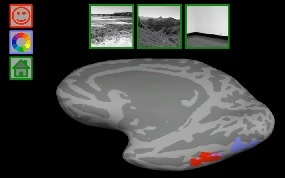
brain - nancyCan one day the brain science tell us “Who we truly are?”

And show the difference between ‘becoming’ and ‘Being’  in a brain scan?

Can a scan possibly differentiate a “Knower of Truth” vs an “Expert on Truth”?

Please watch this Talk (17:40 min) of Nancy Kanwisher, a Professor of Cognitive Neuroscience at MIT. Nancy’s Talk is supported by excellent graphics.

Bhakti in Advaita

“Bhakti” in common parlance is generally taken to mean a sort of Master – slave relationship of a seeker towards a superior Guru/Master/Lord/God, an attitude that in a way does reinforce duality.

Historically speaking, Bhakti as a cult took root in India after the Muslim invasions. The Abrahamic monotheistic religions with their proselytizing spirit attracted the masses offering the promises of a personal God who would fulfill their wants. Perhaps to counter this, indigenous Bhakti cults developed and continue to do so today. 

The Advaita scriptural texts, strictly speaking, do say that devotional approach to a personal deity is an inferior path for Enlightenment. Further, some of them explicitly state that the devotee has to be a “Shiva” himself in order to worship Shiva. Yogavaasishta says a Vishnu only can truly worship a Vishnu. The implication in these statements is that the devotee should lose the sense of being a separate individual from what is being worshiped – it insists on a total identity, Oneness, of the subject-object.

I feel that the techniques like meditation, Bhakti, rituals, pilgrimages etc. are useful at two levels to a seeker:

  • Bhakti etc. will work as a sort of aid to train the mind in its ability to stay focused (instead of wavering) and unbiased (being aware of one’s own hidden prejudices). These two aspects sharpen the mind and make it ready to take up Self-inquiry on one’s own.
  • Bhakti and other such techniques are useful once again at a later stage after the Advaitic message is completely ingested without any doubt but a seeker experiences some difficulty to abide constantly in Brahman. The mind out of its sheer old habit pulls him/her back to the lures of the world from unceasing abidance as Brahman. Using Bhakti and other such things as little crutches, it will be easy for the seeker then to come back to rest as Awareness instead of being driven by the vagaries of the mind.

From:  Place of Bhakti in Advaita – The Reply to the Question, Jul 27, 2012

Q.361 – Advaita and the Brain

Q: Hello, I have a question. Professor V. Ramachandran, a neurologist at UC San Diego, in his research outlined that  the Temporal lobe in the brain, which when excited by electricity results in the individual having a religious experience where they “now understand the cosmos” and feel as one with it. This has been characterized in press reports as “The God Zone”   He tells in his book:  “It seems somehow disconcerting to be told that your life, all your hopes, triumphs and aspirations simply arise from the activity of neurons in your brain. Science— cosmology, evolution and especially the brain sciences—is telling us that we have no privileged position in the universe and that our sense of having a private non-material soul “watching the world” is really an illusion (as has long been emphasized by Eastern mystical traditions like Hinduism and Zen Buddhism).”

So according to modern science, there’s nothing spiritual or paranormal. Consciousness in any form is produced only in the brain. How do those new information fit in the Advaita?

A (Ramesam): The quote of Dr. V.S. Ramachandran, if I am not wrong, seems to be from his 1998 book on “Phantoms in the Brain.”

By the late nineties the thrust given to Neuroscientific research through ‘The Decade of the Brain’ project was coming to an end. As a result of this concerted effort, illuminating light began to shine on many hitherto dark corners of the brain’s way of functioning – be it memory, emotions, thought process, neurological ailments or even the intractable mind-brain relation. The general atmosphere prevailing in those times was that of all round excitement and euphoria about the new findings which opened the doors to promising avenues of research in Neuroscience. Dr. Ramachandran made a name for himself with contributions to the advancement of our knowledge on the alleviation of pain from surgically excised limbs, synesthesia and even the application of neuroscientific principles to art and sculpture. Continue reading

Reality, appearance, and Time

Quotes:

Lord Vishnu: As a matter of fact, the trunk, stem, branches, leaves and so on did not emerge out of the seed. The seed has transformed itself into all of them.

रूपालोक मनस्कार तत्ताकाल क्रियात्मक्म् ।

कुम्भकारो घटमिव चेतोहन्ति करोतिच ॥ — sarga 48 – shloka 52

What is present now is perceived by the senses. What will be in the future is anticipated by the mind by its projection. What was past is remembered by the mind by identifying itself with the past things/ events. Therefore, it can also be said as:

Present Time       rUpAloka kAla        Period of Direct Observation (Perception)

Future Time         manaskAra kAla    Period of Mental Projection (Anticipation)

Past Time            tattA kAla                Period of Mental Identification (Remembrance)

Thus the three times viz., Present, Future and Past are nothing but what the mind makes up like a potter churns out pottery. It is again the mind that makes them disappear.  — p: 84

*****

Sage Gadhi: Pardon me, My Lord! You insist that every event, every ‘thing’ in the world is a phantasm, a creation of the mind. It is quite puzzling to me. Certain things take place in the world as per the Law of Nature regularly on time. If it is taken that the entire world is nothing but a figment of imagination, how can there be a rule or rhyme to it? How can any Law of Nature be valid? The world does certainly seem to revolve around a time frame. How is it possible to attribute it to some fancy? Continue reading