Overview of Western Philosophy – Part 2

Topazwo-33832

(Read Part 1 of the series.)

Part 2 – Metaphysics

Metaphysics, as the study of the questions of ‘life, the universe and everything’ is known, fell out of vogue in the twentieth century, when the attitude arose that most of what had previously been thought to be intransigent problems were not really problems at all but arose through our inability to formulate the problem correctly. Once we used language properly, it was argued, the difficulties would disappear. Many recent philosophers have not even addressed the sort of fundamental questions that are being asked on this site. In this respect there is a similarity with science. There was a time when an enquiring mind could range over the entire domain of what is now thought of as ‘science’, becoming expert in many areas and making new discoveries. The amount of material that was written down and accepted as proven was minimal. Over the past few centuries, the rate of investigation and discovery has accelerated and it is now possible to conduct novel research in only a tiny area of specialisation. In the 3rd Century BC, Aristotle’s multi-disciplined enquiries have already been noted. By the 20th Century, most of the philosophy in England was devoted to analysing the meanings of sentences! Continue reading

The Relevance of Kant’s Transcendental Idealism to Advaita Vedanta, Part III

kant3

The Critique of Pure Reason is a long and intricate text. Most of what I discussed in Parts I and II is material covered just in the Introduction! In this final installment of our Kant series, we’ll briefly discuss the first formal section of the CPR, the Transcendental Aesthetic, where Kant elucidates his radical view of space and time. Also, from a later section of the critique, we will examine Kant’s notion of the transcendental synthetic unity of apperception, and I will argue that he is essentially talking about Atman in Western philosophical terms. Continue reading

Fear from wild creatures – 2

pic2 for AVPart -1

Fear can be caused by a perceived threat which could be either from within the body-mind or from a source external to the body. The source of fear itself and consequently the type of fear can be either real or imaginary. We shall, however, not consider the issues related to the nature of the source causing the fear in this essay. We shall treat fear as a ‘signaling mechanism.’ Viewed thus, ‘fear’ includes all its other manifestations and variations like  anger, hatred, disgust, anxiety, revenge etc. The signal itself appears as tightening of muscles, fastness of breath, heaviness in the heart area, slowness of digestive processes, dilation of pupils of the eye, contortion in the facial muscles, perspiration and so on. Depending on the intensity of the threat, the flux of thoughts may alter and even the sense of a ‘separate self’ may disappear.

A point to be remembered is that, though all such reactions are commonly attributed to the source, the perceived source itself is not the cause. It is in the way one’s body-mind are programmed to react. Suppose you sweat on mistakenly seeing a rope as a snake in semi-darkness. The unreal snake in the rope has actually nothing to do with the way your body has reacted. Continue reading

The Mystery – Part 3

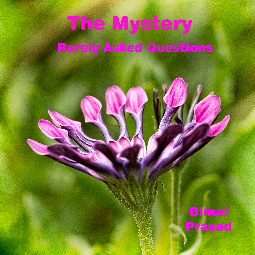
Continuing this new, short series presenting the booklet by Bimal Prasad, in which he answers some ‘Rarely Asked Questions’ on Life. Primarily from the perspective of Advaita, questions addressed include the nature of happiness, consciousness, mind and ego. There is also practical guidance on meditation in the final chapter. Answers are relevant and succinct, so that many of the issues of interest to the seeker are covered.

This third part is entitled ‘Pointers to Consciousness’ and answers questions about the nature of existence, reality, truth and consciousness. See the Contents List or go straight to Part 3 of the series.

The complete (electronic form) booklet may also be purchased from Amazon.

Q.384 – Dark night of the soul

Q: Please help me.I had a temporary glimpse of reality around 15 months ago by following 8 fold path. I tried to penetrate the question of suffering and learned that everything wants to come into Equilibrium (a known chemistry fact) due to which my thought trains stopped and I got an instant realization of something called reality. After that, I experienced I am a silent witness and not mind, body, ego, etc.

This faded away after some time and now I am in mental anguish and turmoil. I don’t know what is happening in my mind but it is disturbed or in what people call the “Dark night of soul”. Every joy is lost now; I get angry easily and have feelings of despair from something. Maybe it is because I didn’t discipline my mind with ethics before starting this practice for enlightenment. Please save me now. Whatever is going on in my head, save me from it. I don’t know how to complete surrender unto reality and may be this is due to the hold of ego. Please help!

A (Dennis): The teaching tradition of Advaita is all about Self-knowledge. You listen to the teaching from a qualified teacher (ideally) or read about it and discuss it (less good). You ask questions about it to resolve your doubts. Eventually, you realize that what is being said is true and that is that. In theory!

The problem is that you need a clear, self-controlled mind and some trust in the teacher, the ability to discriminate and so on. These ‘skills’ are not really a part of Advaita – they are mostly lifted from Patanjali’s Yoga system. If you have no mental discipline along these lines, you are never going to be able to assimilate the teaching. You need at least a medium level of attainment. With that you can take on board the knowledge and then continue your practices until you reap all the other benefits (peace of mind, fearlessness and so on).

From what you say, I would advise that you forget about Self-knowledge for a while and concentrate on acquiring the mental skills. Meditation is invaluable. And, if you have no religious-type outlook (praying to a god and so on), then the practices of karma yoga are the other main route – doing what is in front of you because it needs doing, ignoring desires and not expecting any results. And so on!

I do not know anything about Buddhist methods so cannot really comment. I would forget about ‘dark nights’. The main thing to remember, even if you don’t yet believe it, is that the world is not absolutely real. Your body, mind and everything else have empirical reality only, depending ultimately on Consciousness, which is the only reality. And you are That.


Fear from wild creatures – 1

scared “I understand the Advaita teaching that everything is One only without a second, but I am always afraid of dogs and monkeys which are common in my place. Moreover, I also have a fear of snakes etc. as I live in a forest area.

Everything is brahman and therefore, ‘fear’ is also brahman.  Though my mind is convinced by the logic of Advaita, why do I suffer from various fears?”

If there is a perception of fear, it automatically implies that there is a ‘me’ as the ‘subject,’ the finite perceiver and there is the ‘other,’ an object, separated from ‘me.’  (For this analysis, we define an ‘object’ as anything that is perceived. Hence ‘fear’ is also an object). This in turn implies that I ignored my ‘Dimensionlessness’ (anantatva) and assumed finiteness to myself.

It is true that on the full understanding of the Oneness of “Whatever-That-IS,” there is no scope for any sort of ‘fear.’ After all, if all is One, and there is no second, where and who is the other to be afraid of?

We have a recent real-life example for this in the 35th Pontiff of Sringeri, Shri Abhinava Vidyatheertha Swami. He found a big cobra snake coiled around his neck when he was meditating in a remote forest area. He told his Successor: Continue reading

Free Will versus Fatalism


Below is another essay from Atman Nityananda whose earlier essay on sAdhana triggered so much interest. This is preceded by an essay on the same topic from Swami Sivananda.


Free Will versus Fatalism
by Swami Sivananda

The controversy between free will and fatalism is still going on in the West and no one has come to any definite conclusion. It is a great pity that the doctrine of Karma is mistaken for fatalism. Fatalism is the doctrine that all events are subject to fate and happen by unavoidable necessity.

Fate is otherwise known as luck or fortune. That indefinable mysterious something which brings trials, successes and failures to man, which shapes and moulds him by teaching lessons of various sort, which takes care of him like a mother, which brings various sort of experiences, which brings cloudy days and days of bright sunshine, which raises a beggar to the level of a landlord and hurls down a mighty potentate to the level of a street-beggar, which gives different kinds of fruits and experiences to two people of equal talents and capacities, which made Napoleon at one time a terror in the eyes of the people and at another time a prisoner, and which makes a certain portion of the life of a man quite stormy and another portion quite smooth, is called fate. Fate educates and instructs man. However whimsical the fate may appear to operate, it works in harmony with the law of causation. Continue reading

Nisargadatta terminology

A frequent contributor to the site, Vijay Pargaonkar has provided the following valuable information rearding the terminology of Nisargadatta Maharaj:

When references to Nisargadatta Maharaj and his teachings come up at the AV forum during discussions, the arguments often seem to become tangential. I think this is mainly due to the differences in terminologies and definitions used by the followers of Nisragadatta and the ones used in traditional Advaita forums.

Last week I came across a rare Satsang tape in Marathi where Maharaj clearly lays out his version of the Creation Model and Prakriyas while explaining various Advaita terms according to his definitions. I have excerpts of this Satsang translation (as I heard and understood) below, where I have indicated the Sanskrit/Marathi terms along with the English terms used by the translator – the translator has actually chopped the live recording and inserted his English translation in between.

Creation Model

Prior to your waking is Nirguna, the substratum of Waking. The Nirguna is not at all bothered by this samara (samara = ‘war (of life)’). In Nirguna appeared knowledge (Bodha).  This is pure Consciousness or Beingness or the Sense “I am” that has no shape or form. In this pure Consciousness there appeared a slight perturbation or movement and the pure Consciousness then grabbed a body-form (deharupa). After wearing this body form it started calling itself a man or woman while bound by different concepts (I am this; I am that; I am going; I am coming etc.). These concepts are all imaginary (Kalpana) and not real. Continue reading

Does spiritual practice empower the ego?

Does sAdhana (spiritual practice) empower the ego?
An essay by Atman Nityananda

If you abandon sAdhana in order to avoid this sAdhana-ego you are left with nothing except egoism. Egoism plus sAdhana is better than egoism minus sAdhana.
~Swami Sivananda

Liberation is the dissolution or the death of the ego which is a field of energy crystallized in our bodies. Liberation has nothing to do with an enlightened ego. There cannot ever be an enlightened or liberated ego.

Liberation is neither for the ego nor for the consciousness which is already free. Liberation is for the mind. When the mind after intense spiritual practice (sAdhana) becomes free from all egoistic tendencies, rajas and tamas then liberation takes place for none and the mind celebrates its unity with the spirit or Consciousness.

But some neo-advaita or non-teachers as they call themselves like Tony Parsons claim that the spiritual practices empower the ego instead of dissolve it. They claim that is impossible the ego to be eliminated by sAdhana by the very fact that the sAdhana is done by the ego. They say that sAdhana and the dissolution of ego is a contradiction because the ego itself is engaged in sAdhana and this keeps the ego alive. Continue reading

Q. 383 – Alzheimers

Q: Does an enlightened one stay enlightened when he gets Altzheimer’s disease? You seem to be saying that enlightenment is knowledge, self knowledge. Can one loose that knowledge again?

A (Dennis): This is the sort of question that first requires very careful definition of terms. What do you mean by ‘enlightened’? Who is the ‘one’ you are asking about? Who gets Alzheimer’s? Who loses the knowledge?

Do these questions answer your question? Have you read my ‘chidAbhAsa’ and ‘manonAsha’ articles?

A short answer might be that body, mind, intellect and world are all mithyA. Consciousness is the only satyam. And Consciousness does not get Alzheimer’s.