Haldane Philosophy

Here is a short poem, contributed by Ananda Wood (a direct disciple of Sri Atmananda Krishna Menon) and inspired by the book Philosophy of a Biologist by J.S. Haldane.

Here is what he says to introduce the poem:

I recently came across a book by J.S. Haldane, called Philosophy of a Biologist. I found it interesting because of its approach through reflective enquiry. In particular, I was interested by Haldane’s account of Western Philosophy from Descartes and Spinoza onward.

In particular, Haldane discusses philosophical questions progressively: in relation to Physical Science (Ch. I), Biology (Ch. II), Psychology (Ch. III), Religion (Ch. IV). And he concludes with a short chapter called Retrospect, where he approaches God as the inmost spirit of a universal personality. This is done in much the same way as the purusha-prakriti duality is used by Shri Shankara to investigate beyond all “knower-known” or “subject-object” duality.

This led me to write a piece of verse called Scientific enquiry: which tries somehow to summarize Haldane’s line of investigation. Continue reading

Are you just happy or really, truly happy?

happy sam2Ānanda is of two types): ātmā ānanda and koṣa ānanda (we will retain the word ānanda without translation because it loses its expressiveness in translation). We need to understand the difference between these two types of ānanda before entering into the enquiry.

Ātmā ānanda means fullness – the very nature of one’s own self. Every individual’s intrinsic nature (svarūpam) is ānanda. Vedānta says: you are happiness, because you are fullness. Just as heat is the intrinsic, inseparable property of fire, so too happiness or fullness is the real nature of the individual. Continue reading

Advaita – not the only teaching

As readers will know, this site is wholly dedicated to Advaita as the teaching of the non-dual nature of reality. But I came across a reminder today that there are other sources for this truth! It is an extract from a book on Hasidic Judaism, which was posted by Jerry Katz to his NDhighlights Ezine. It reads like pure Advaita:

Reb Yerachmiel ben Yisrael
19 Tevet 5636

My Dear Aaron Hershel,

You ask me of God: to define the Nameless to place in your palm the ultimate secret. Do not imagine that this is hidden some­where far from you. The ultimate secret is the most open one. Here it is: God is All.

I am tempted to stop with this-to close this letter, sign my name and leave you with this simple truth. Yet I fear you will not understand. Know from the first that all that follows is but an elaboration on the simple fact that God is All.

What does it mean to be All? God is Reality. God is the Source and Substance of all things and nothing. There is no thing or feel­ing or thought that is not God, even the idea that there is no God! For this is what it is to be All: God must embrace even God’s own negation. Continue reading

Creativity – Q.332

Q: What happens to creativity (writing painting music… ) when you awake from the dream of dualism ?  

A (Peter): What happens to waves when they are known to be nothing but water? Do all waves lose their distinctiveness? Do they suddenly freeze mid-motion?

 It is an error to believe that either there is a blank, distinctionless ‘non-duality’ or a rich, exciting, variegated universe. There is only consciousness and every exciting, beautiful thing – gross and subtle – is an expression of it. The painting, the act of painting, the impulse to paint, the paint, the brush, the painter are all an expression of the secondless, non-dual consciousness. Continue reading

Kaṭha Upaniṣad Review

The Kaṭhopaniṣad with Śaṅkarabhāṣyam
Based on Swami Paramārthānanda’s lecture
Compiled by Divyajñāna Sarojini Varadarājan

The main teaching of the Kaṭha Upaniṣad is Death’s response to the request by a young seeker, Naciketas, for Self-knowledge. Any serious student of advaita will want to know the answer as this is our own question too: using logic we may well be able to arrive at what we are not, but we still need to know clearly what we are. For this reason this book by Smt. Sarojini Varadarajan, based on Swami Paramarthananda’s traditional unfoldment of the Upaniṣad and Śaṅkara’s commentary theron, is a valuable addition to any seeker’s library.

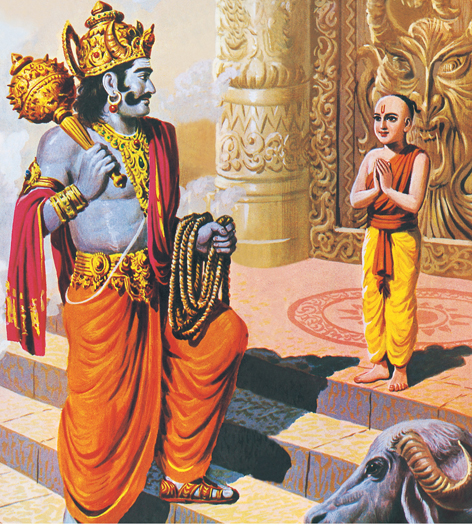
One way of approaching this Upaniṣad is to note that Naciketas standing at Death’s door (literally) remained steady-minded enough to press his request for Self-knowledge – in spite of Death’s initial resistance to answer. And, by the end of the Upaniṣad, after Death finally gave in to the young man’s request, Naciketas ‘became pure and immortal’. Is it really possible that we can also reach the same point by closely following the teaching that Naciketas hears, especially as we are living lives grounded in fear? Continue reading

Beyond Stillness – Q. 331

Q : I am a “solo practitioner” of the advice of Ramana Maharshi, as I understand what I absorb of it. My enquiries move between an apophatic and cataphatic flavor.

 When I do this, I am moved to an absolute stillness. Upon ‘coming back’, there is a sensation of still not passing the barrier of stillness. I am not sure how to continue. Should I continue to practice just like this? Until I have destroyed differentiation? Should this be a lesson on what the real really is?

[Note (Dennis): Here are the meanings of those terms from my Oxford dictionary –

apophatic /ap’fatk/ – adjective Theology (of knowledge of God) obtained through negating concepts that might be applied to him. The opposite of cataphatic.

cataphatic /kat’fatk/ – adjective Theology (of knowledge of God) obtained through defining God with positive statements. The opposite of apophatic.] Continue reading

Vision Of Truth (sad darshanam – 5)


Arbhyate jIva jagat parAtma

tattvAbhidhAnena matam samastam

idam trayam yAvadahamatiH syAt

sarvottamASham mati shUnya niShThA—4


Arbhyate = begins;  jIva jagat parAtma = divisions of individual, world and Ishvara; 

tattvAbhidhAnena = principles of the three tattvAs;  matam samastam = all philosophies; 

idam = this; trayam = three;  yAvat = as long as; ahamatiH = ‘I’ notion; syAt = is there;

sarvottamA = the greatest of all; aham mati shUnya = devoid of ego; niShThA = 

abidance; 


All philosophies begin based on the principles of the three divisions of individual, world and Ishvara. The abidance in self, devoid of the ego is the greatest abidance of all.


All religions are based on the three divisions of individual, total and world. These religions culminate in some philosophy which again is based on this triad only. Theology sticks to these divisions and does not attempt to go beyond. Continue reading

Ānanda – our Svarūpam

When I went to a school, I asked the Children what are they in the school for? Someone said “to study”. I asked “Study for what?” “So that we can pass the examination with good marks” pat came the reply. “Why should you score good marks in the exams?” “So that we can get a good job?” “Why do we need a good job?” “So that we can earn a lot.” “Why do we need to earn a lot?” “So that we can buy things that we want.” “Why do we need to buy things that we want?” “So that I can be happy.”

What if you are Happiness here and now? What if Happiness is your Svarūpam? Please pause to think about the profundity of this possibility…..

Svarūpam, the word means one’s intrinsic nature. Like even heat and light are the intrinsic nature of fire.

Ānanda – it is a nuetral state; it is neither Happiness nor Sadness. It is neither bliss, for ignorance can be bliss. Ānanda is a state of equilibrium when one is at peace with oneself and the world.

We can logically arrive at Ānanda as our Svarūpam. How? Let’s analyze.

Continue reading