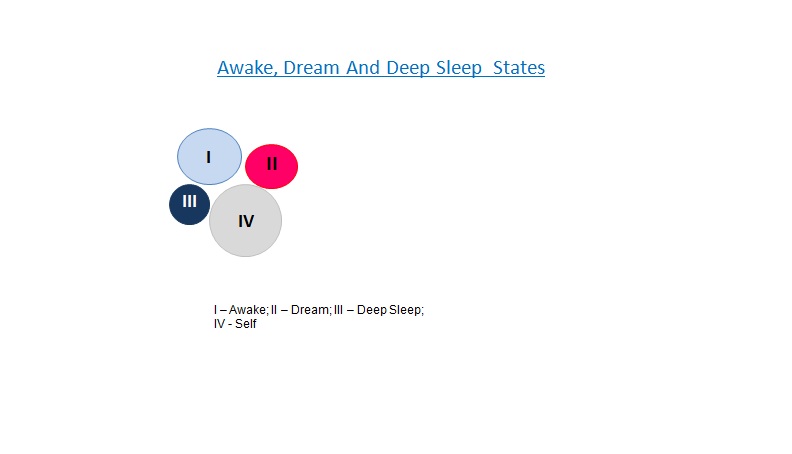
In my Talk on “Inquiry in Science and Vedanta “, the slides numbered 50 and 51 are about the three states of consciousness — Awake, Dream and Deep Sleep. (The full PowerPoint Presentation can be viewed at : http://beyond-advaita.blogspot.in/ ). The three worlds are represented by the three distinct circles I, II and III and a ‘Me’ is shown by the circle IV in the Slide 50 (Fig. 1 below). In our normal understanding, we think that “I am a separate ‘self’ (individual) and I pass through three distinct worlds viz. the Wakeful world, the Dream world and the Deep Sleep world.” We also take that the worlds to be external to ‘me.’
Book Extract – Bhagavadgita: The Celestial Song

Extract: Action in Non-Action from the new book by Raphael.
Raphael interprets Shankara’s comments on the famous verse IV.18 from the Bhagavad Gita:
One who sees non-action (akarma) in action (karma) and action in non-action, is the wisest among men, he is one who has realized yoga, who has fulfilled everything.
The Dream Problem part 9

Part 9 of the New Book Serialization!
The Sage tells the dreamer about the various levels or stages that he must pass through (i.e. his knowledge and understanding must progress) on the ‘path’ to jIvanmukti.
Investigating yourself
This is an invitation to reflect on the reality of one’s own self identity.
In the tradition of Advaita Vedanta the distinction between one’s three bodies is basic. For Westerners this way of looking at things requires a change of thinking. Continue reading
Incomplete Enlightenment – Q.333
Q: As I understand, the sense of “I” (distinguished from the ultimate I/Self) is the source of “ignorance”. “Ignorance” leads to “the fear”, which inspires us to attempt to find “enlightenment”. The attempt to find “enlightenment” is the delusion that there is something to gain. The teachings tell us that “enlightenment” is the nature of existence. What needs to happen is the destruction/removal of ignorance, rather than the acquisition of anything. I already feel as if I have approached the “screen” upon which phenomenon occurs. By practicing “neti neti”, I attempt to see what always is, which is a temporary attempt to disregard things that can be seen. Once this happens, there is the inference of blankness/darkness/all-inclusiveness/voidness. And once this practice of “neti neti” is over, I begin to see things come of themselves, from little sparks … flakes of concepts … to their blooming as a climax of a concept. The climax wanes and the concept disappears of itself just as it arose.
A short time after this attempt at enquiry, the ease I had with reality fades. The sense that reality is not okay begins to gradually return. It feels as if I missed something from this experience. At other times, I feel as if perhaps this effort is part of the problem. Maybe the enquiry is meant to be a last ditch attempt to notice the fallacy of trying to do something, or even the attempt to try to do nothing.
Is this the realization? That effort is resistance? That surrender to this fact is the ultimate motion?
How does it happen that one can know “in the mind” that one is free, and yet continue to fall back into the conundrum of no longer feeling this freedom? Moments of complete freedom … knowing that it’s not my business to “do” life, not even to attempt to not “do” life … and yet slowly fall back into the habit? Continue reading
Haldane Philosophy

Here is a short poem, contributed by Ananda Wood (a direct disciple of Sri Atmananda Krishna Menon) and inspired by the book Philosophy of a Biologist by J.S. Haldane.
Here is what he says to introduce the poem:
I recently came across a book by J.S. Haldane, called Philosophy of a Biologist. I found it interesting because of its approach through reflective enquiry. In particular, I was interested by Haldane’s account of Western Philosophy from Descartes and Spinoza onward.
In particular, Haldane discusses philosophical questions progressively: in relation to Physical Science (Ch. I), Biology (Ch. II), Psychology (Ch. III), Religion (Ch. IV). And he concludes with a short chapter called Retrospect, where he approaches God as the inmost spirit of a universal personality. This is done in much the same way as the purusha-prakriti duality is used by Shri Shankara to investigate beyond all “knower-known” or “subject-object” duality.
This led me to write a piece of verse called Scientific enquiry: which tries somehow to summarize Haldane’s line of investigation. Continue reading
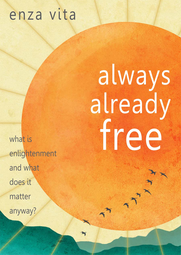
Book Extract – always alread free

Recognizing Who You Are –
an extract from the forthcoming book by Enza Vita (and the offer to download the first 3 chapters).
You live in confusion and the illusion of things. There is a reality. You are that reality.
When you know that, you know that you are nothing, and in being nothing, are everything. That is all.
— Kalu Rinpoche
Are you just happy or really, truly happy?
Ānanda is of two types): ātmā ānanda and koṣa ānanda (we will retain the word ānanda without translation because it loses its expressiveness in translation). We need to understand the difference between these two types of ānanda before entering into the enquiry.
Ātmā ānanda means fullness – the very nature of one’s own self. Every individual’s intrinsic nature (svarūpam) is ānanda. Vedānta says: you are happiness, because you are fullness. Just as heat is the intrinsic, inseparable property of fire, so too happiness or fullness is the real nature of the individual. Continue reading
Advaita – not the only teaching
As readers will know, this site is wholly dedicated to Advaita as the teaching of the non-dual nature of reality. But I came across a reminder today that there are other sources for this truth! It is an extract from a book on Hasidic Judaism, which was posted by Jerry Katz to his NDhighlights Ezine. It reads like pure Advaita:
Reb Yerachmiel ben Yisrael
19 Tevet 5636
My Dear Aaron Hershel,
You ask me of God: to define the Nameless to place in your palm the ultimate secret. Do not imagine that this is hidden somewhere far from you. The ultimate secret is the most open one. Here it is: God is All.
I am tempted to stop with this-to close this letter, sign my name and leave you with this simple truth. Yet I fear you will not understand. Know from the first that all that follows is but an elaboration on the simple fact that God is All.
What does it mean to be All? God is Reality. God is the Source and Substance of all things and nothing. There is no thing or feeling or thought that is not God, even the idea that there is no God! For this is what it is to be All: God must embrace even God’s own negation. Continue reading
Creativity – Q.332
Q: What happens to creativity (writing painting music… ) when you awake from the dream of dualism ?
A (Peter): What happens to waves when they are known to be nothing but water? Do all waves lose their distinctiveness? Do they suddenly freeze mid-motion?
It is an error to believe that either there is a blank, distinctionless ‘non-duality’ or a rich, exciting, variegated universe. There is only consciousness and every exciting, beautiful thing – gross and subtle – is an expression of it. The painting, the act of painting, the impulse to paint, the paint, the brush, the painter are all an expression of the secondless, non-dual consciousness. Continue reading