samAdhi (part 2)

Experience versus knowledge – a brief look at samAdhi (Part 2)

(Read Part1)

Here is the 364th verse of the vivekachUDAmaNi, as translated by Swami Ranganathananda, of Ramakrishna Math: “Reflection should be considered a hundred times superior to hearing, and meditation a hundred thousand times superior even to reflection, but the nirvikalpa samAdhi is infinite in its results.” The verse is referring to shravaNa, manana and nididhyAsana initially and, traditionally, this is the ‘complete set’, taking one all the way to realization and jIvanmukti.  But here, it goes on to imply that nirvikalpa samAdhi is vastly superior. As Swami Ranganathananda puts it: “Our first hand experience of the non-dual reality is infinitely greater than meditation. They can’t be compared… no wise man would give up the infinite bliss of non-dual experience and revel in unsubstantial things like reading and thinking. Reading, thinking and meditation are nothing compared to the direct experience of the reality.

But here, one has to ask the question: who is experiencing what? And, if it is an experience (i.e. in time), it has a beginning and necessarily an end also. How does this stack up with the idea that NS equates to Self-realization? Swami Satprakashananda even says later in the book that few seekers attain NS and even fewer return to ‘normal consciousness’ subsequently. “Their experience of NS is, as a rule, of short duration and hardly repeated. They leave the body in that state and attain Liberation (videha mukti). In exceptional cases the body stays alive in NS for twenty one days at the most, and then drops like a dry leaf.” Continue reading

Knowing brahman (Awareness)

Our Scriptures repeatedly impress on us that the Ultimate Truth can never be known by a “me” by taking any amount or type of action. “brahman” is known only by “Knowing.”  Puzzlingly, It knows Itself!

Here is a selection of a few mantras for deep contemplation as we enter the New Year:

1नायमात्माप्रवचनेन लभ्यो न मेधया न बहुना श्रुतेन । 

     यमेवैष वृणुते तेन लभ्यस्तस्यैष आत्मा विवृणुते तनूं स्वाम् ॥  — 3.2.3, muNDaka. Continue reading

Trip to India – 4

Sw-s Subraya Sharma, Ramachandra Iyer & Sowmya

The Adhyatma Prakasha Karyalaya was founded by Swamiji [1880-1975] in 1920, its first location being Bangalore, which has persisted, but reduced in size in comparison with the next location: It then became well established in 1937 in Holenarsipur, 1 and ½ h. from Bangalore, where he spent his last years. Swamiji’s intention was to publish the works of Shankaracharya along with those of Gaudapada and Suresvara, all of those that are based on Prasthanatraya. His own extensive work has also been published there, as well as several journals – in Sanskrit, Kannada, and English. Continue reading

Sanskrit: language of the gods part 2


Here is the second of a two-part essay by Peter Bonnici, explaining why Sanskrit is so valuable and why a qualified teacher is necessary. (One of a number of essays, blogs and book reviews by myself and others which I will be reposting here over the next few months (they can no longer be found on-line at present). Dennis


Sanskrit: language of the gods (Part 2) – Peter Bonnici

(Read Part 1)

The ability of Sanskrit to convey truth expressed through the vision of advaita is the holy grail pursued by Paul Douglas in ‘Language and Truth’. The explicit influences on Douglas’s understanding of Sanskrit come from two main sources: his spiritual guide, Shantananda Saraswati, one time AcArya of Jyotir Math in BadrinAth, and the linguist and grammarian BhatRRihari. In that sense it is a devotee’s book, a book that explores the language to validate the teachings of the guru, in particular, one of his statements: ‘The grammatical rules of Sanskrit are also the rules of creation’.

The book gives the general reader a good insight into the building blocks of the language and to the evolution of nouns and verbs from seed form (dhAtu) to fully inflected word in a sentence (pada). In clear, readable language we are given insights into the elements of Sanskrit that support the premise that the author wants to understand. Continue reading

Trip to India – 3


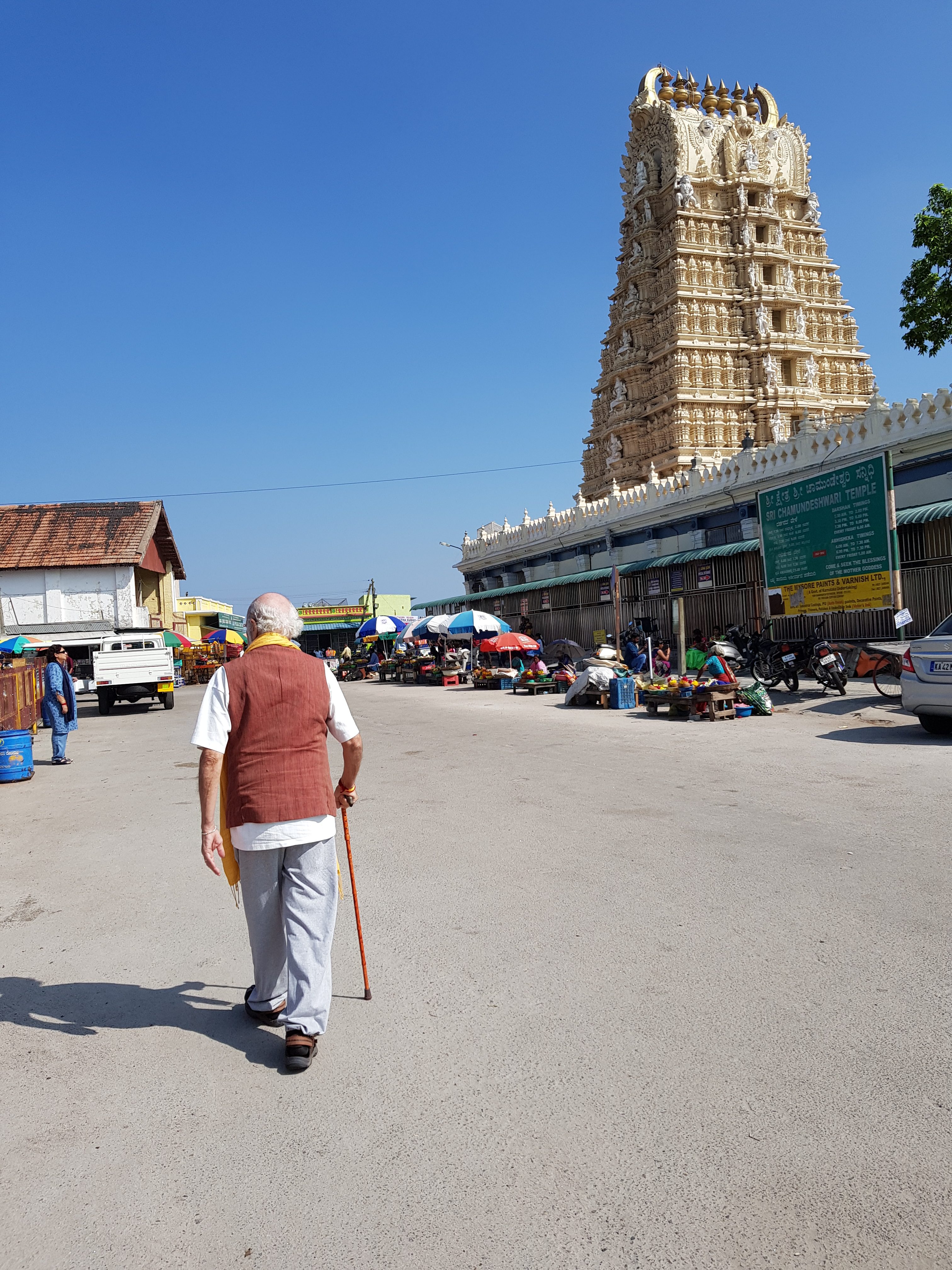
On the third day Sowmya, my wife and I went over to Ramachandra’s house and he accompanied us to visit Subraya Sharma. Ramachandra Iyer, a saintly swami with a persistent gentle smile in his face and of few words, is someone you can be quite at ease with in company, so unobstructive and unassuming  is he. Sowmya  (I was told) calls him ‘uncle’, even if there is no blood relationship between them. He has just turned 72 years of age and lives with his wife, one son and his wife, and two young  and sprightly grand-daughters.

At Subraya Sharma’s home (he is the one who took care of Swamiji for 16 years of the latter’s life) we were offered milk in a small glass and some granulated sugar (one was supposed to drink the milk and swallow the sugar after putting it in the palm of one’s hand and may be grind it between one’s teeth before swallowing – this is what I did). Continue reading

Trip to India – 2

As I wrote in part l of this Travelog, I never expected that I would be talking on three occasions in front of an audience and in three different locations. Before departing to India I had asked Sowmya (a 29 years old MD and accomplished Advitist) what could I talk about if the occasion arose, assuming that there would be at least one presentation I should be making. Sowmya told me that the topic  could be the article I wrote (published serially in Advaita Vision in 2017) in defense of SSSS (‘Swamiji’ henceforth) which took me so long to write – 16 pp long vs. the 40 pp of the article by Ramakrishnan Balasubramanian. Continue reading

samAdhi (part 1)

Experience versus knowledge – a brief look at samAdhi

I do not know an awful lot about neo-Vedanta. The term is generally applied to the teaching ‘introduced’ by Swami Vivekananda and carried on by the disciples of the Ramakrishna movement. There has been much written on this topic (which I have obviously not read!) and those who are interested will know that there are many contentious issues. Refer, for example to the book ‘Neo-Vedanta and Modernity’ by Bithika Mukerji, which may be read or downloaded at http://www.anandamayi.org/books/Bithika2.htm.

However, one aspect that I am aware of is that neo-Vedanta claims that enlightenment is attained through the experience of nirvikalpa samAdhi. They also insist that Shankara himself stated this, whereas what I would call ‘traditional’ Advaitins believe that Shankara’s teaching was that it is self-ignorance that obscures our understanding of the truth and that only self-knowledge can remove it. Thus, one of the key issues around the topic of neo-Vedanta is that of experience versus knowledge. Accordingly, at the risk of inciting acrimonious discussions (!), I would like to look briefly at this assertion that samAdhi is a sine qua non for enlightenment. Continue reading

Sanskrit: language of the gods part 1


I am in the process of reviewing old material relating to Advaita Academy as part of my background research for a 2nd edition of Back to the Truth. There are a number of essays, blogs and book reviews by myself and others which I will be reposting here over the next few months (they can no longer be found on-line at present). Here is the first of these – a two-part essay by Peter Bonnici, explaining why Sanskrit is so valuable and why a qualified teacher is necessary. Dennis

Sanskrit: language of the gods – Peter Bonnici

There are many who declare themselves to be students of advaita vedAnta but do not see the value in pursuing the study of texts in Sanskrit as they believe that the proliferation of translations and commentaries on texts like the Upanishads and Bhagavad GIta available in native languages are sufficient. Then there are those who have a working knowledge of Sanskrit who feel that, armed with a dictionary and other necessary tools, they can arrive at the meaning of texts by themselves.

Both are missing something, and for the same reason: namely, the enormous expressiveness, subtlety and flexibility of the language to express the precise meaning that the speaker or writer wishes to convey. (Most of the valuable teaching of advaita was passed on orally and the written form came later.) Not only is one missing out the subtlety of meaning by side-stepping the language, but one can also be lulled into a false sense of security by the book knowledge one has. An example of this can be seen when one compares translations. Here are three translations of the first verse of shankara’s DakShiNamUrti Stotra:

Continue reading

Trip to India

Trip to India – l

(Don’t expect here a sequel to ‘A Search of Sacred India’, by the well-known author Paul Brunton)The thought of going to India came to mind – despite my advancing age and unsteady gait- through the contact with a user of Quora with whom I had been relating quite well through that medium. There are a number of such users who are either followers of the great Vedantin of the past Century, Shri Satchidanandendra Saraswati, or acquainted with his writings. Through that contact I learned that two Swami-s who took care of SSSS, one of them during the last 16 years of his life and the other during the last year (1975) were still alive and living in Bangalore, the city where my contact, Sowmya, lives (there must of course be other close followers of that sage in other areas of India, but we are now talking about Bangalore (or Bengaluru, as recently renamed) and some of the people who live there. With the indispensable help and support of my wife, we took to India without thinking it twice. Continue reading