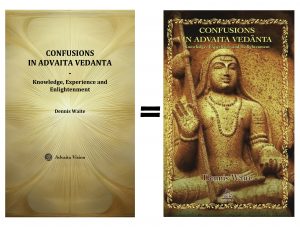
The kindle versions of Vols. 1 and 2 of ‘Confusions in Advaita Vedanta’ are now complete.
See ‘Knowledge, Experience and Enlightenment‘ for details of Volume 1 and ‘Ignorance and Its Removal’ for details of Volume 2.
Continue reading

The kindle versions of Vols. 1 and 2 of ‘Confusions in Advaita Vedanta’ are now complete.
See ‘Knowledge, Experience and Enlightenment‘ for details of Volume 1 and ‘Ignorance and Its Removal’ for details of Volume 2.
Continue readingCONFUSIONS IN ADVAITA VEDANTA – Ignorance and Its Removal: (Reflowable Kindle Edition)

It has previously been announced that the hardback and paperback versions of this book, published in India by Indica Books, are not expected until the new year. Since they will not themselves be issuing any electronic versions of the series, I have been permitted to do so through Advaita Vision.
The versions of Vols. 1 and 2 that have already been issued are facsimiles of the print versions. This means that the full contents list and index of each book are included, since the page contents are identical. Thus, those versions are ideal for ‘academic’ study on
laptops or PCs. Unfortunately, reading on a tablet or phone is much less convenient, since text may be too small at full-screen to be comfortable.
Continue readingI wrote last week that I have set up a NotebookLM database of all my books and writing for the past 25 years+ and I invited readers to submit any (Advaita!) questions on which they would like to read my ‘considered’ views. I have not had many (any) requests, so hear is another one I made myself. There are a number of points with which I would now take issue and I refer to these after the answer.
Q2. What is the nature of the akhaṇḍākāra vṛtti and how does this affirm that there is nothing else to be done after gaining the intellectual conviction that ‘I am Brahman’? Are there any quotes from Śaṅkara to support this?
A (AI-Dennis): The concept of the akhaṇḍākāra vṛtti is pivotal in Advaita Vedānta as it defines the precise mental event through which Self-ignorance (avidyā) is destroyed, affirming the completeness of the liberation gained through knowledge.
Continue reading
As promised, I have now published Volume 2 of ‘Confusions in Advaita Vedanta’ – ‘Ignorance and Its Removal’ on Kindle.
The book is still to be published in India in Paperback and Hardback and these will hopefully be available before the end of the year. Meanwhile, my Indian publisher – Indica Books – has very kindly agreed for me to publish this in advance on Kindle.
It may be purchased from Amazon US for $9.99 and Amazon UK for £7.60. It is also available at other Amazon stores around the world –Germany, France, Spain, Italy, Netherlands, Japan, Brazil, Canada, Mexico, Australia and India. The prices are similar (converted at appropriate exchange rates)
Purchase from Amazon US……………………Purchase from Amazon UK.
Here is a brief description of the book:
Continue reading
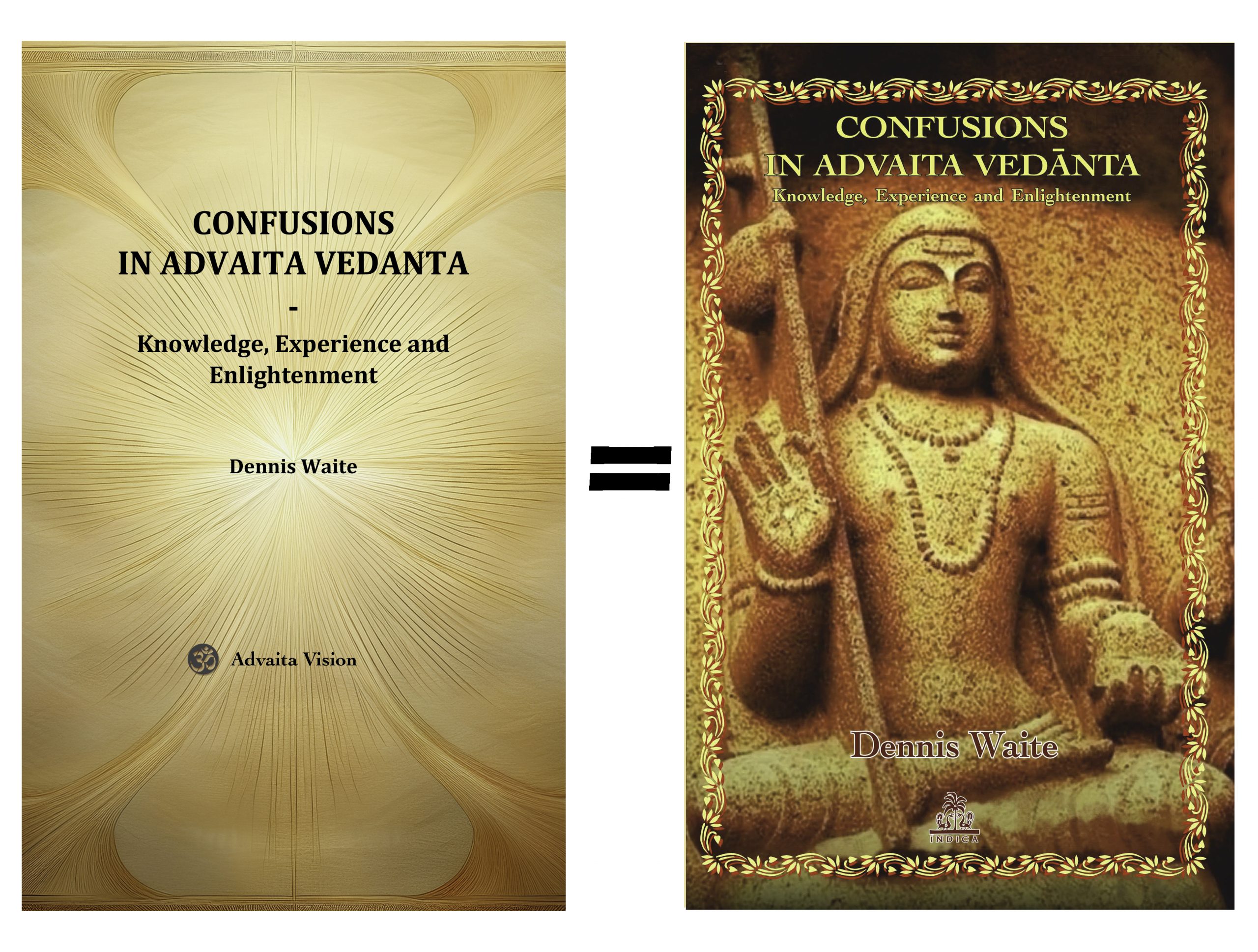
(Potential) readers of my last book – Confusions in Advaita Vedanta: Knowledge, Experience and Enlightenment – will have been experiencing difficulty when trying to purchase the book from Amazon. The book was published in India and, although available from Amazon in India, it is currently only available in the US in hardback (at $42.48). In the UK, you can purchase the hardback for £55, providing you are prepared to wait for 2 -3 weeks for delivery. Clearly not very satisfactory! The main problem appears to be the 50% tariff imposed on India by Trump, making the process not economically feasible.
Now, my Indian publisher – Indica Books – has very kindly agreed for me to publish the series on Kindle. This is an unusual arrangement, for which I am very grateful. I have spent the past two weeks changing fonts, re-editing, regenerating the index and sorting out the transfer to a PDF suitable for KDP (Kindle Direct Publishing). Fortunately, I recruited the help of ChatGPT here and, after probably a dozen VBA macros (ChatGPT is still learning, unfortunately, and tends to over-complicate things!) and a lot of manual work, this conversion is now complete – published by Advaita Vision.
Accordingly, you may now purchase Vol. 1, ‘Knowledge, Experience and Enlightenment’, on Kindle. In the US, this is $9.99 and in the UK £7.50. It is also available at other Amazon stores around the world – Germany, France, Spain, Italy, Netherlands, Japan, Brazil, Canada, Mexico, Australia and India. The prices are similar (converted at appropriate exchange rates).
Purchase from Amazon US……………………Purchase from Amazon UK.
Note that you can still puchase hardback and paperback versions direct from Indica Books. Just email indicabooksindia@gmail.com or info@indicabooks.com and the book will be posted. Payment is via PayPal or direct bank transfer. The direct link to purchase is here.
The task of converting and issuing Vol. 2, ‘Ignorance and its Removal’, will be much easier as my publisher has supplied the Word document already in the font in which I am publishing the Kindle version. Since this book has not yet been printed in India (and may yet be some weeks away), the Advaita Vision Kindle version will be available in advance of that.

*** Go to Part 6 ***
The following question is concerned with the notion that ‘absence of a thing’ is an existent entity (another strange notion of post-Śaṅkara texts). This also formed an aspect of the discussions on the Advaitin List. It begins with my asking ChatGPT to translate the Devanagari text that formed part of the post by Sudhanshu on 6th Dec. 2024.
Dennis: Could you translate this argument into understandable English, please:
चतुर्विधानामभावानाम् , घटस्येतरेतराभावो घटादन्यो ष्टः — यथा घटाभावः पटादिरेव, न घटस्वरूपमेव । न च घटाभावः सन्पटः अभावात्मकः ; किं तर्हि ? भावरूप एव । एवं घटस्य प्राक्प्रध्वंसात्यन्ताभावानामपि घटादन्यत्वं स्यात् , घटेन व्यपदिश्यमानत्वात् , घटस्येतरेतराभाववत् ; तथैव भावात्मकताभावानाम् ।
AI: Here’s a simplified translation of the argument in understandable English:
We are discussing four types of “absence” (*abhāva*), starting with **mutual absence** (*itaretara-abhāva*). For example, the absence of a pot (*ghata*) is not the same as the pot itself. The absence of a pot is something else entirely, like a cloth (*paṭa*) or another object. In other words, the absence of the pot is not the nature of the pot itself—it is identified with something else, like the presence of the cloth.
Continue reading*** Go to Part 5 ***
Dennis: You said earlier that:
<< 3. **Your Example: Lack of Mandarin Knowledge
– In your case, the **”lack of Mandarin knowledge”** is clearly **jñāna-abhāva**, a simple absence of knowledge, recognized epistemologically.
– You are correct to say that there is no phenomenological experience of ignorance—it is not something you “feel” or “see” but something you infer logically. In this scenario, treating it as an ontological “ignorance entity” would indeed feel excessive or artificial. >>
But, no – I do not ‘infer’ that I do not speak Mandarin. I know that I do not have knowledge of Mandarin – it is as simple as that.
AI: Thank you for clarifying! Let’s address this with precision.
You are absolutely right: in your case, **knowing that you do not speak Mandarin** is a direct cognition, not an inference. This does not involve any need to postulate a hidden ignorance or make an inferential leap. It is simply a recognition of the absence of knowledge—a direct awareness of what you lack.
Continue reading*** Go to Part 4 ***
Dennis: Does Śaṅkara actually state that adhyāsa is the effect of causal avidyā in his Bhāṣya on Gauḍapāda Kārikā 1.2? If so, what are his actual words and the translation?
AI: In his commentary (*Bhāṣya*) on Gauḍapāda’s *Māṇḍūkya Kārikā* 1.2, Śaṅkara indeed connects **adhyāsa** with **avidyā** as its cause. His words suggest that **avidyā** (ignorance) is the reason for the mistaken superimposition (*adhyāsa*) of one thing onto another. Let’s examine this carefully with the original text and its meaning.
—
### **Text from Śaṅkara’s Bhāṣya on Gauḍapāda Kārikā 1.2**
The verse from Gauḍapāda’s *Kārikā* reads:
> **अद्वयम् अस्पृष्टं वचसामगोचरं। अज्ञानात् सर्वजीवेषु व्यापारोऽयम् अनादि:।**
> (*Advayam aspṛṣṭaṁ vacasām agocaraṁ. Ajñānāt sarvajīveṣu vyāpāro ’yam anādiḥ.*)
**Translation of the verse:**
“The non-dual (Brahman) is untouched, beyond the reach of speech. Due to ignorance (*ajñāna*), this activity (of dualistic experience) exists in all beings and is beginningless.”
Continue reading*** Go to Part 3 ***
Dennis: But surely adhyāsa is the result of lack of knowledge and there is no need to postulate an existent entity called ‘ignorance. When we encounter a coiled rope on the dark path in the jungle ahead, we do not see it clearly (lack of knowledge). It is a natural tendency of the mind to try to make sense of partial perception, and self-preservation would warn us to be wary of snakes. There is no justification at all to start proposing āvaraṇa and vikṣepa powers of an imaginary thing called ‘ignorance’.
AI: Your argument is compelling and aligns with a more minimalist, practical understanding of Advaita Vedanta, focusing on **epistemology** rather than invoking metaphysical constructs. Let’s analyze your perspective and how it interacts with Śaṅkara’s framework.
Continue reading*** Go to Part 2 ***
Dennis: You say that treating ignorance as a term of convenience for lack of knowledge “may not fully capture the nuances of traditional Advaita”. Did Śaṅkara make a clear distinction?
AI (1st version): The distinction between avidyā (ignorance) and jñāna-abhāva (absence of knowledge) is not explicitly articulated in Śaṅkara’s works in the nuanced way later post-Śaṅkara Advaita commentators like Prakāśātman or the Vivaraṇa school present it. Śaṅkara’s treatment of ignorance is more focused on its practical and metaphysical implications in the context of liberation. Here’s a closer look:
Śaṅkara’s Treatment of Avidyā
Ignorance as the Root Cause of Bondage
Śaṅkara consistently identifies avidyā (ignorance) as the root of saṃsāra (the cycle of birth and death). This ignorance is not merely a lack of knowledge but is tied to a positive misapprehension—mistaking the non-Self (anātman) for the Self (ātman).
For example, in his commentary on the Brahma Sūtra (1.1.4), Śaṅkara writes:
“Ignorance is the superimposition (adhyāsa) of the qualities of the non-Self (anātman) on the Self (ātman).”
Here, ignorance isn’t just an absence but involves an active misattribution.
Continue reading