
The taittirIya Upanishad explains brahman as:
सत्यं ज्ञानमनन्तं ब्रह्म । — 2.1.1, taittirIya upa.
[Beingness, Knowingness and Infiniteness is brahman.]
Unending Beingness and Knowingness is the nature of brahman.
There are two endpoints for anything in this world — one is the beginning and the other is the ending. But brahman, The Knowingness, as the Upanishad says is Infinite, without limitations or edges or endpoints. It has neither a beginning (origination) nor an end (culmination).
From a common sense point of view, it may be argued that “Knowingness” cannot exist on Its own in the absence of a knower and something to be known. Can Knowingness ‘be’ in a vacuum? Is Its presence not dependent on a knower who would have been the locus for It? In the usual parlance, knowingness is that which interlinks the ‘knower’ with the ‘known.’ With the two end-members being absent, can ‘Knowingness’ exist on its own independent of the other two? Continue reading
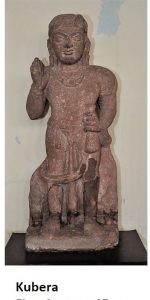 [The world and everything in it are imaginary (mithya) ‘names and forms’! Therefore, tradition depicts Ishwara as a pauper because he does not possess any worldly wealth. However, he transcends the worldly objects and is said to be an embodiment of the Self. In contrast, Kubera possessed a lot of worldly treasures, a collection of mere names and forms, but lacked the real wealth of Self-knowledge. So, he sought guidance from Ishwara.]
 Narada climbs up the staircase from Name up to Spirit almost hopping and jumping spurred by his own enthusiasm and curiosity. He asks his venerable teacher at each step after meditating, “What’s next?” He, however, falls absolutely silent after meditation at the level of Spirit, the 15th itself. He has another flight of steps to take to reach the Ultimate, the Absolute!
 Shankara opens his commentary on the 6th chapter of chAndogya with a very brief intro. bringing out the context of Svetaketu’s story and its relationship (sambandha) to the rest of the Upanishad. He says that the 6th chapter explains two important points, which are: