Does spiritual practice empower the ego?

Does sAdhana (spiritual practice) empower the ego?
An essay by Atman Nityananda
If you abandon sAdhana in order to avoid this sAdhana-ego you are left with nothing except egoism. Egoism plus sAdhana is better than egoism minus sAdhana.
~Swami Sivananda

Liberation is the dissolution or the death of the ego which is a field of energy crystallized in our bodies. Liberation has nothing to do with an enlightened ego. There cannot ever be an enlightened or liberated ego.

Liberation is neither for the ego nor for the consciousness which is already free. Liberation is for the mind. When the mind after intense spiritual practice (sAdhana) becomes free from all egoistic tendencies, rajas and tamas then liberation takes place for none and the mind celebrates its unity with the spirit or Consciousness.

But some neo-advaita or non-teachers as they call themselves like Tony Parsons claim that the spiritual practices empower the ego instead of dissolve it. They claim that is impossible the ego to be eliminated by sAdhana by the very fact that the sAdhana is done by the ego. They say that sAdhana and the dissolution of ego is a contradiction because the ego itself is engaged in sAdhana and this keeps the ego alive. Continue reading
Q. 383 – Alzheimers

Q: Does an enlightened one stay enlightened when he gets Altzheimer’s disease? You seem to be saying that enlightenment is knowledge, self knowledge. Can one loose that knowledge again?

A (Dennis): This is the sort of question that first requires very careful definition of terms. What do you mean by ‘enlightened’? Who is the ‘one’ you are asking about? Who gets Alzheimer’s? Who loses the knowledge?

Do these questions answer your question? Have you read my ‘chidAbhAsa’ and ‘manonAsha’ articles?

A short answer might be that body, mind, intellect and world are all mithyA. Consciousness is the only satyam. And Consciousness does not get Alzheimer’s.

Time Does Not Exist

Truth will set you free: Time Does Not Exist by Hans Meijer

Why time does not exist

When we ask ourselves why we think time exists, most of us would say: because we see everything changing, always. And so it is: everything in and around us is constantly changing, from beginning until the end.

The question however is: is the reason for this perpetual change to be found outside the changing subject (caused by a phenomena called time) or is all change coming from inside the changing subject itself?

I don’t think that it is hard to see that the latter is correct. That which makes things change (the cycle of life) to a flower, a human being or an animal is set by the characteristics of that particular life’s form and not by an outer cause such as time. What we call ‘time’ is just a method for measuring the ‘perpetual change’.

Because of our need to measure this perpetual change we decided to divide the ‘cyclic changes’ such as seasons and day and night, into months, twenty-four hours, minutes etc. These well-known changes are caused by the ever-moving planetary positions within our solar system and not because there exists such a thing as ‘time’.

So, there are no minutes, but we decided that after counting 60 (seconds) we say that a minute has passed. Based on minutes we calculate hours, days, months, years, centuries etc.

In this way we can count the number of heartbeats per minute, years from birth to death and we even can calculate the number of years from the Big Bang until today.

But we also say: ‘it seems as if time has stood still (in that old village), nothing has changed`.

Actually there is only NOW – in which all that is manifested appeared, changes and disappears. Continue reading

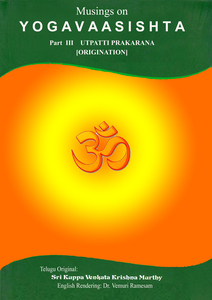
Serialization of Yogavasishta 4

yogavasishta3

Professor Sri Kuppa Venkata Krishna Murthy, Chairman and Managing Trustee of I-SERVE, the Institute of Scientific Research on Vedas, has kindly given permission for Advaita Vision to serialize his 6-volume ‘Musings on Yogavasishta’. Written in Telugu, the work has been painstakingly translated by our Dr. Ramesam Vemuri and published by Avadhoota Datta Peetham.

Rather than reproducing successive extracts from the books each month, as has been done with our other two serializations, the books themselves will be made available for download in PDF format. Each part will be associated with a page at the main website, which will contain a Contents List for that volume. Links to all of the volumes will be provided on a general Contents Page.

The fourth part to be published is Part 3 (ORIGINATION). (We began with Part 7 of the Series as it provides an overall summary of the Non-dual teaching and is a better introduction than simply jumping in at Part 1.) As Ramesam puts it: “The main thrust of the teaching by Sage Vasishta is that the visible world has no real origination. He establishes that the space-time-causation of the phenomenal world is illusory and arises out of pure mentation.” A timely coincidence with Charles’ series on Kant, where he notes that “Kant’s position, therefore, translated to Advaita terms, is that space and time are only valid in the context of transactional (vyAvahArika) reality, and therefore not truly Real (pAramArthika).”

Please go to the Contents Page to read the Announcement and general introduction from Ramesam. The page for this Third Volume, Part 3 (ORIGINATION) also contains the download link for the PDF file (0.9MB).

Q. 382 – Art and Vedanta

Q: As an artist and casual reader of advaita-vedanta, I wanted to ask about advaita-vedanta’s opinion on Art (be it music, painting, dance etc.).

Generally speaking, we can classify art into broadly 2 categories – sentimental art and non-sentimental art. But, as a practitioner of the former and a student of the latter (I had strict classical music training), I almost think of myself as being ‘attracted’ to art – as in, there is this sense of desire to create music. Personally, I have been advised by several elders to continue producing and practicing music. But does this go against the advice of advaita-vedanta? Am I acting on desires? Will art get artists permanently stuck in the cycle of samsara?

I ask this question because – There are so many Slokas, mantras, verses (sam-veda) that are musical… so it seems like music is encouraged by the vedas and the upanishads. But at the same time, it seems like a thing of desire. This confusion needs to be cleared!

Responses from Martin, Charles, Ted and Dennis Continue reading

Vedanta the Solution – Part 27

venugopal_vedanta

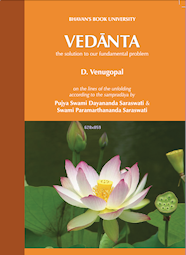
VEDĀNTA the solution to our fundamental problem by D. Venugopal

Part 27 begins the enquiry into the nature of the jIva. It looks at the various explanations for how Consciousness manifests in the body-mind and the special role of the buddhi.

There is a complete Contents List, to which links are added as each new part appears.

Tattvabodha – Part 12

OLYMPUS DIGITAL CAMERA

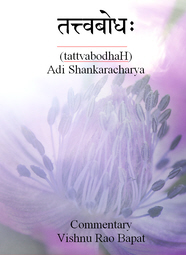
Part 12 of the commentary by Dr. VIshnu Bapat on Shankara’s Tattvabodha.This is a key work which introduces all of the key concepts of Advaita in a systematic manner.

The commentary is based upon those by several other authors, together with the audio lectures of Swami Paramarthananda. It includes word-by-word breakdown of the Sanskrit shloka-s so should be of interest to everyone, from complete beginners to advanced students.

Part 12 examines the waking and dream states of experience.

There is a hyperlinked Contents List, which is updated as each new part is published.

Overview of Western Philosophy – Part 1

TTopazwo-33832his is the first part of an 18-part overview of Western Philosophy. Originally written to be incorporated into ‘Book of One’, it became far too long and detailed. I posted the first 15 parts to Advaita Academy around 5 years ago but these are no longer available. Since we have a current interest in the subject with both Charles and Martin posting articles and comments, it seems like an opportune time to begin to repost the series!

Note that the depth to which the subject is addressed is fairly shallow for the most part. I am not a philosopher by education or employment and most of my understanding has been gleaned from secondary sources – I have read very few original philosophical texts! But I hope it provides a general introduction to the key ideas of most well-known Western philosophers so that the reader may go to the original source (or a good commentary) if interested. Needless to say, I tend to ‘cherry-pick’ those aspects that related to Advaita!

What Western Philosophers Have Said

A site such as this would be unthinkable without reference to what has been thought and written by Western philosophers. Philosophers used not to limit their investigation to those areas that we now think of as philosophy. Aristotle for example wrote books on physics, biology, mathematics, psychology, politics and meteorology, to mention just a few. Their interests ranged across the entire spectrum of human endeavour. It should not be too surprising, then, to find that many philosophers do not seem specifically to have addressed those questions that concern Advaita – there were simply too many other diverting subjects to investigate. Nevertheless, since the question of what we ought to do with our lives in order to achieve fulfilment and happiness is rather more important than most, it is perhaps surprising that it seems so difficult to discover clear guidance from this intellectual elite. Continue reading

The Mystery – Part 2

bimal_cover

Continuing this new, short series presenting the booklet by Bimal Prasad, in which he answers some ‘Rarely Asked Questions’ on Life. Primarily from the perspective of Advaita, questions addressed include the nature of happiness, consciousness, mind and ego. There is also practical guidance on meditation in the final chapter. Answers are relevant and succinct, so that many of the issues of interest to the seeker are covered.

This second part looks at the distinction between ‘I’ and the body-mind and identifes ‘Consciousness’ as being who we really are. See the Contents List or go straight to Part 2 of the series.

The complete (electronic form) booklet may also be purchased from Amazon.

OM

om copy

Everyone (reading this blog!) has heard of the syllable ‘OM’. The Devanagari for this is the immediately recognizable ॐ but it is made up of three letters, a, u and m. Thus, it could actually be represented as औम् and the ITRANS, instead of being written OM, would be ‘aum’.

How OM can function as a symbol for brahman or the entirety of creation is elucidated by Gaudapada and described in my book ‘A-U-M: Awakening to Reality’. Here is the section that describes the Sanskrit aspects:

*****

The spoken word ‘OM’ is actually Sanskrit. The written ‘OM’ is its ‘Romanized’ representation (i.e. using the English alphabet). In its original language, it actually looks like this:

If you have ever been to India, this character will be very familiar and it also frequently appears on New Age items and jewelry. But this is in fact a special, shorthand representation and the word is actually formed from three separate letters. (Only this word, in the entire language, has a special symbol – this is an indication of how important it is considered to be.) Continue reading