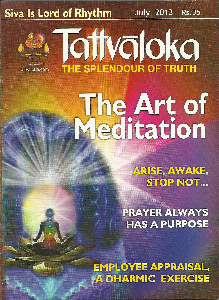
Bhakti and j~nAna are the same

“Of all the means to liberation, devotion is the highest. To seek earnestly to know one’s real nature – this is said to be devotion.” – Shankara, Vivekachudamani.

“Devotion consists of supreme love for God. It is nectar. On obtaining it, man has achieved everything; he becomes immortal; he is completely satisfied. Having attined it, he desires nothing else. Having realized that supreme Love, a man becomes as if intoxicated; he delights only in his own intrinsic bliss.” – Narada, Bhakti Sutras.

Just as the Self and the soul cannot be separated one from the other, neither can j~nAnI and bhakti be spearated; though mutually exclusive, they co-exist as complements in everyone. And as our knowledge grows, we must learn to adapt our vision of the world to accept and embrace apparently contradictory views. We must learn to feel comfortable with the notion that a quantity of energy is both a wave and a particle; that our lives are determined, and that we are free; that our identity is both the Whole and the part. We are the universal Self; we are the one Consciousness – and we are also the individualized soul, which consists of the mind and its own private impressions. We are the Ocean – but we are also the wave.

The Supreme Self, Swami Abhayananda, O-Books. ISBN: 1905047452. Buy from Amazon US, Buy from Amazon UK. Review Link

Q.361 – Advaita and the Brain

Q: Hello, I have a question. Professor V. Ramachandran, a neurologist at UC San Diego, in his research outlined that  the Temporal lobe in the brain, which when excited by electricity results in the individual having a religious experience where they “now understand the cosmos” and feel as one with it. This has been characterized in press reports as “The God Zone”   He tells in his book:  “It seems somehow disconcerting to be told that your life, all your hopes, triumphs and aspirations simply arise from the activity of neurons in your brain. Science— cosmology, evolution and especially the brain sciences—is telling us that we have no privileged position in the universe and that our sense of having a private non-material soul “watching the world” is really an illusion (as has long been emphasized by Eastern mystical traditions like Hinduism and Zen Buddhism).”

So according to modern science, there’s nothing spiritual or paranormal. Consciousness in any form is produced only in the brain. How do those new information fit in the Advaita?

A (Ramesam): The quote of Dr. V.S. Ramachandran, if I am not wrong, seems to be from his 1998 book on “Phantoms in the Brain.”

By the late nineties the thrust given to Neuroscientific research through ‘The Decade of the Brain’ project was coming to an end. As a result of this concerted effort, illuminating light began to shine on many hitherto dark corners of the brain’s way of functioning – be it memory, emotions, thought process, neurological ailments or even the intractable mind-brain relation. The general atmosphere prevailing in those times was that of all round excitement and euphoria about the new findings which opened the doors to promising avenues of research in Neuroscience. Dr. Ramachandran made a name for himself with contributions to the advancement of our knowledge on the alleviation of pain from surgically excised limbs, synesthesia and even the application of neuroscientific principles to art and sculpture. Continue reading

Bhakti – Limitation of Accepted Paths

In our search for Truth, beginning with an examination of the world before us, we use
as our instrument the faculty of reason. This reason can well be divided into two. One
is lower reason, which is exercised by the mind in examining the mutual relationship
of objects, from intellect down to the gross world. The other is higher reason or
transcendental reason, which is exercised in examining the mind and its objects –
gross or subtle – with a view to discover their real content.

There are usually three accepted paths to the Truth. They are the paths of devotion,
yoga and jnyana. Of these three, devotion and yoga deal only with relative things
falling within the sphere of the mind and sense organs, taking into consideration only
experiences in the waking state. Their findings, therefore, can only be partial and
incomplete.

The jnyana path looks from a broader perspective and comprehends within its scope
both yoga and devotion. It takes into consideration the whole of life’s experiences – comprised in the three states – viewed impartially. It demands a high degree of real
devotion, in the sense that the aspirant has to have a high degree of earnestness and
sincerity to get to the Truth. This is real devotion, to Truth; and it is infinitely superior
to devotion to anything else, which can only be less than the Truth.

The yogin controls, sharpens and expands the mind to its maximum possibilities,
attaining samadhi and powers (or siddhis) on the way. But in the case of those who
follow the jnyana path, the mind is analysed impartially and minutely; and proved to
be nothing other than pure Consciousness itself, beyond which there is no further
power or possibility of development.

So it is through jnyana alone that Truth can be visualized, while yoga and devotion
only prepare the ground for it.

Note 63, Notes on Spiritual Discourses of Shri Atmananda: Volume 1, Shri Atmananda and Nitya Tripta, Non-Duality Press, ISBN: 978-0-9563091-2-9. Buy from Amazon US
Buy from Amazon UK.

upadesha sAhasrI – Part 20

upadesha20

Part 20 of the serialization of the  presentation (compiled by R. B. Athreya from the lectures given by Swami Paramarthananda) of upadesha sAhasrI. This is the prakaraNa grantha which is agreed by most experts to have been written by Shankara himself and is an elaborate unfoldment of the essence of Advaita.

Subscribers to Advaita Vision are also offered special rates on the journal and on books published by Tattvaloka. See the full introduction

Q.360 – Suffering

OLYMPUS DIGITAL CAMERAQ: I have tried several spiritual paths and I was always stopped in my search by this question: How do we explain suffering?. Why does all pervading, partless, actionless Consciousness create, allow, dream of Auschwitz? Surely Consciousness could do better than this?

Answers are provided by: Ted, Martin, and Sitara. For answers by Dennis, see Q.24 and Q.33 and Q.62 and Q.120 and Q.294.

A (Ted): Your question is certainly understandable. It is the same question just about everybody has at an early stage in their spiritual understanding. It is based on a fundamental erroneous assumption we make about the nature of reality due to the conditioning we receive either directly from religion or indirectly from the religious beliefs that undergird the generally accepted perception of reality that informs the society.

 Our mistaken assumption is that awareness is an anthropomorphic (i.e. human-like) entity who has some overarching personal agenda and is orchestrating—or at least overseeing—the activities and events transpiring in the world with a vested interest in their nature and results. But this is not the nature of awareness. Continue reading

Topic of the Month – bhakti

The topic for July 2014 is bhakti.

Along with many others, I used to think that there were 3 paths to enlightenment: karma, bhakti and j~nAna. I now know better! There is only one ‘remedy’ for saMsAra j~nAna, since only knowledge can eliminate ignorance. But karma yoga is valuable for mental preparation and bhakti is an attitude that should prevail throughout. It is also excellent as a starting point for many. We also need to differentiate bhakti and upAsana

Please submit your quotes, short extracts or personal blogs on this topic!

Nathan Gill

Quote

gillNathan Gill (1960 – 2014)

Enlightenment:

As Consciousness You are already awake and aware. In the play of life when there is exclusive focus as the individual, Your true nature is forgotten and there is complete involvement in searching for enlightenment or awakening. But You already are aware, already completely awake; it’s simply that this is veiled by appearances, the story of ‘me’ as an individual.

Whenever Your true nature is remembered the spell is broken. The pursuit of enlightenment is clearly seen as nothing more than the cosmic lIlA. Awakeness is already the case under all circumstances, regardless of contrary appearances in the play.

Transmission:

The guru and the disciple appear as images in the cosmic lIlA – the play of life. Maybe the storyline in the play is that through grace the disciple receives the blessing of the guru, and for as long as there is entrancement with the story of ‘me’ this can be an enthralling drama. In actuality though there is no transmission of anything from one to another because there simply isn’t anyone.

Practice:

No one becomes enlightened because in actuality there isn’t anyone. Only within the story in the play of life does striving to transcend individuality appear to have validity.

There is no individual that could become enlightened; no one that needs to attain or realize anything. The drama of striving to achieve enlightenment through various practices is limited to the play of appearances. What practice is needed to simply be?

All quotations from private Emails, reproduced in Back to the Truth: 5000 Years of Advaita (Paperback), Dennis Waite, O Books, Feb 2007, ISBN-10: 1905047614. Buy from Amazon.com or Amazon.co.uk

Knowledge and the Fruit of Knowledge

OLYMPUS DIGITAL CAMERAFollowing on from the l-o-n-g discussion we had on this topic under the thread ‘akhaNDAkAra vRRitti – The End of Suffering‘, I have written what was intended to be the commentary on kArikA 3.40 in my next book (OM: Waking Dreams… and Reality), which covers the essence of this discussion. I have decided that I will probably simplify this considerably for the book, because it is intended to be an accessible and readable book, rather than an academic one. But, because of its relevance, I am posting the entire section, as first written, below.

You now know all about adhyAropa and apavAda and acknowledge that all of the teaching is only interim, to be used to lead us to the final understanding and then discarded. The corollary to this is that, in principle at least, any teaching could be used for this purpose. If it works, it is valid. So it is hardly surprising that there are other methodologies altogether, which can have the same ultimate purport, e.g. Zen Buddhism, Taoism, Kabbalah etc. (I don’t have any personal knowledge of these other systems but understand that their essential teaching is non-dual.)

As far as Advaita Vedanta is concerned, the finer details of the teaching differed from one teacher or branch to another, both before and after Shankara. And some modern-day proponents tend to adhere to some elements and some to others that are apparently contradictory. None of this matters in the final analysis but does tend to lead to some quite heated discussions on the Internet! Continue reading

Q. 359 – Some potential practices

sleeperQ: As a long-time Krishnamurti fan, I often “practice” awareness (mindfulness): when a thought arises I watch it live out its life and disappear; when I sip coffee I am aware of the feel of it, the taste, the fact that I am sipping coffee, etc.

 1. Is it okay for me to continue doing this while I am studying Advaita Vedanta? (OK in the sense of not undermining the Advaita learning process.)

 2. Does Advaita hold that is valuable/beneficial to practice this kind of nonjudgmental awareness? Is there a similar practice in Advaita?

A: According to (traditional) Advaita, you are supposed to have gained sAdhana chatuShTaya before you embark upon the formal path of self-enquiry (shravaNa-manana-nididhyAsana). This includes shamAdi shakti sampatti, the sixfold ‘accomplishments’. And the first of these are shama and dama, tranquil mind and sense control. This is obviously a similar sort of idea to mindfulness. So any practice which helps bring the mind under control, so it is not thinking about something else while supposedly giving attention to Advaita, is fine. But very definitely the idea is become disciplined first, so that you can direct the whole of your attention. If you try to do it at the same time, you will end up doing neither well! Continue reading