
 We all know that the shruti predominantly adopts the model of adhyAropa–apavAda (superimposition – sublation) in imparting the incommunicable Advaita message. There are other types of models and prakriyA-s also available in the scripture and tradition but they do not seem to be as popular. The adhyAropa–apavAda model superimposes an “imagined” or illusory creation on the really real Reality and as the student ingests the core Advaitic teaching, the superimposition is sublated. We find, however, that the shruti spends more time dealing with diverse aspects of the superimposed creation (birth, sustenance, death, action, fruits of action, rebirth etc.), the sublation being left to the ingenuity of the student as s/he reaches her/ his final understanding. One teacher estimates that Shankara in general devotes 90 percent of his time in most of his works on expiation of the Advaita doctrine and the attendant practices, leaving only a minor part on sublation and the outcome of the practices. This situation in some quarters has given rise to an insistence that the shruti teaches creation and that we have to take only the shruti vAkya-s and Shankara’s commentary on them as the pramANa (reference standard) for understanding the Advaita message forsaking other methods and vAkya-s in the scripture. Is that the intention of shruti? What is the final position of the shruti about creation from an Advaita perspective? Continue reading
#1 – A journey into the Truth that you Are what you seek!(11 mins)
OM!
When life takes us from Seeking to Searching!

Life is a constant seeking for happiness and contentment by all (no exceptionso) in the following fields:
- Securities (arthA)- wealth, property, better paying jobs, etc.
- Pleasures (kAmA)- luxury car, mansion, exotic vacations, expanded friend circle, etc.
- Religion (dharmA)- accumulating brownie points through worship, good deeds, etc. to take us to a Heaven after death
In the quest for preferably uninterrupted happiness through all transactions, all the time, everywhere and through everyone and everything we come in contact with, the early part of life frantically engages us in secular actions one after another mainly in the fields of pleasures and securities. As age and maturity catch up, some discerning peope start failing to see consistent happiness in material objects and relationships and slowly turn towards God and devotion, still seeking happiness there though! This shift now drives them to indulge in more sacred actions than secular like social service, pilgrimages, fasts and other austerities. Many don’t feel complete even after having sought Religion. They might have everything in life and yet continues an unexplained, nagging itch in the heart which wants something more. That itch may turn to questions– “Why do I seek relationships to make me feel loved, complete and happy?” “Why do I need the world(which includes situations, behaviour of people, etc.) to be a particular way for my happiness?” “Is this ever-changing physical body the real “I”?” “Why am I not comfortable with the idea of death and losing people I love?” “What is God?” “Is my purpose here just to eat, sleep and procreate or is there a greater meaning to all this?”
This seeking process doesn’t follow a specific linear order of progression for all but is an average blueprint for man’s general behavioural progress!
Vedanta the Solution – Part 58
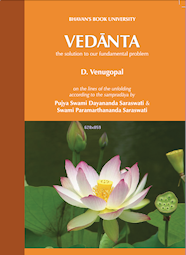
VEDĀNTA the solution to our fundamental problem by D. Venugopal
Part 58 continues the detailed explanation of the process of shravaNa, manana and nididhyASana.
There is a complete Contents List, to which links are added as each new part appears.
Beginner Series – Blogs on advaita vedAntA!
OM!

Namaste🙏 and welcome! I am Priya, a humble seeker and privileged student of advaita vedAntA under the tutelage of Swami Paramarthananda. Having benefitted greatly from a changed life perpective that the beautiful teachings of vedAntA have granted me, I wish to share the liberating knowledge with others who may be interested.
I propose to take you on a journey, one that is fun, full of exciting twists and turns with many new things to learn and discover, through a series of blogs. Every other trip we’ve been on so far has left us with beautiful memories. This is one journey that will change inside out the very One making the memories! Be ready to be introduced to a new, upgraded version of yourself at the end of this journey! Ready yourself for the biggest change of your life!
This journey will be in the form of blogs written in simple language incorporating everyday examples. The highest, most profound and subtlest teachings of the self and God as expounded by the vedic vision of advaita vedAntA will be unfolded here. The word “unfolding” is of significance here! Many of us spiritual seekers in the initial phase of enthusiastic spiritual seeking read and listen to matters pertaining to spirituality in a very random fashion from literally all over the place. While this is certainly not bad, such randomness is not very fruitful and productive in terms of the results it yields. Afterall, the very idea we pursue spirituality is to effectuate change in the way we live and react rather than it simply remaining as an intellectual collection of new jargon in our already crowded, busy minds. Just as a folded, ironed shirt has to be carefully unfolded in order for it to be usuable, spiritual teachings, if they have to be of good use to us mentally and emotionally, necessarily HAVE to be unfolded and received in a very systematic manner and that is the aim of these blogs.
Whom are these blogs for?
The world is in dire need of love, peace, satisfaction, compassion, contentment, kindness, unity, happiness. Today we are living life focussed on the most superficial differences which results in dividing us more and more. As long as we continue to stay divided at the level of race, colour, Religion, language, etc. any chances for happiness, untity and peace will only be a far cry. Spiritual study is the means of going past the differences even while living in them, by effectuating shift in the very way we think by teaching us to turn our awareness towards the unifying factor that connects us all. Such study is beyond the scope of Religion which still is at the realm of difference. That means, anyone with an open enough mind ready for change, belonging to any group, culture, country, sect, race or religion is welcome to join the journey.
Why read my blogs?
No, I am no learned teacher but an enthusiastic seeker and student as much as you are. That means I have the same questions and doubts that you have! By writing these blogs, from my standpoint I stay completely immersed in the teachings which helps my understanding and assimilation better while from your standpoint I will raise the same kind of doubts and questions that might pop up in your mind. There is absolutely no taking away or replacing the process of receiving these profoundly subtle teachings from an Enlightened teacher!
I am blessed with a compassionate preceptor who gives me the teachings and also am fortunate to have plenty of time to devote to spiritual study. Into seemingly simple, short blogs, many many hours of study and contemplation go. I am happy to consolidate my efforts into blogs which might run to be about 12-14 minute reads every 10 days initially and then every 15 days as things start getting hotter! That gives a busy person enough ‘catch up time’ to take it in before the next blog is published. You don’t have to scramble and search the internet for more spiritual information, they will come to you in the right sequence as they came to me, at the right time! advaita vedAntA texts are in Sanskrit(what is considered the Mother of all Languages) and I will provide Sanskrit equivalents in red wherever appropriate. In the blog, points that I would normally consider important enough to highlight while studying will appear in green. The title will be followed by an average reading time in brackets to indicate how much time will approximately be needed for the blog.
Join me on a journey like none other and experience for yourself all the wonderful possibilities that lay ahead!
OM! Peace!
Picture credits:pixabay.com
Trip to India – part 6
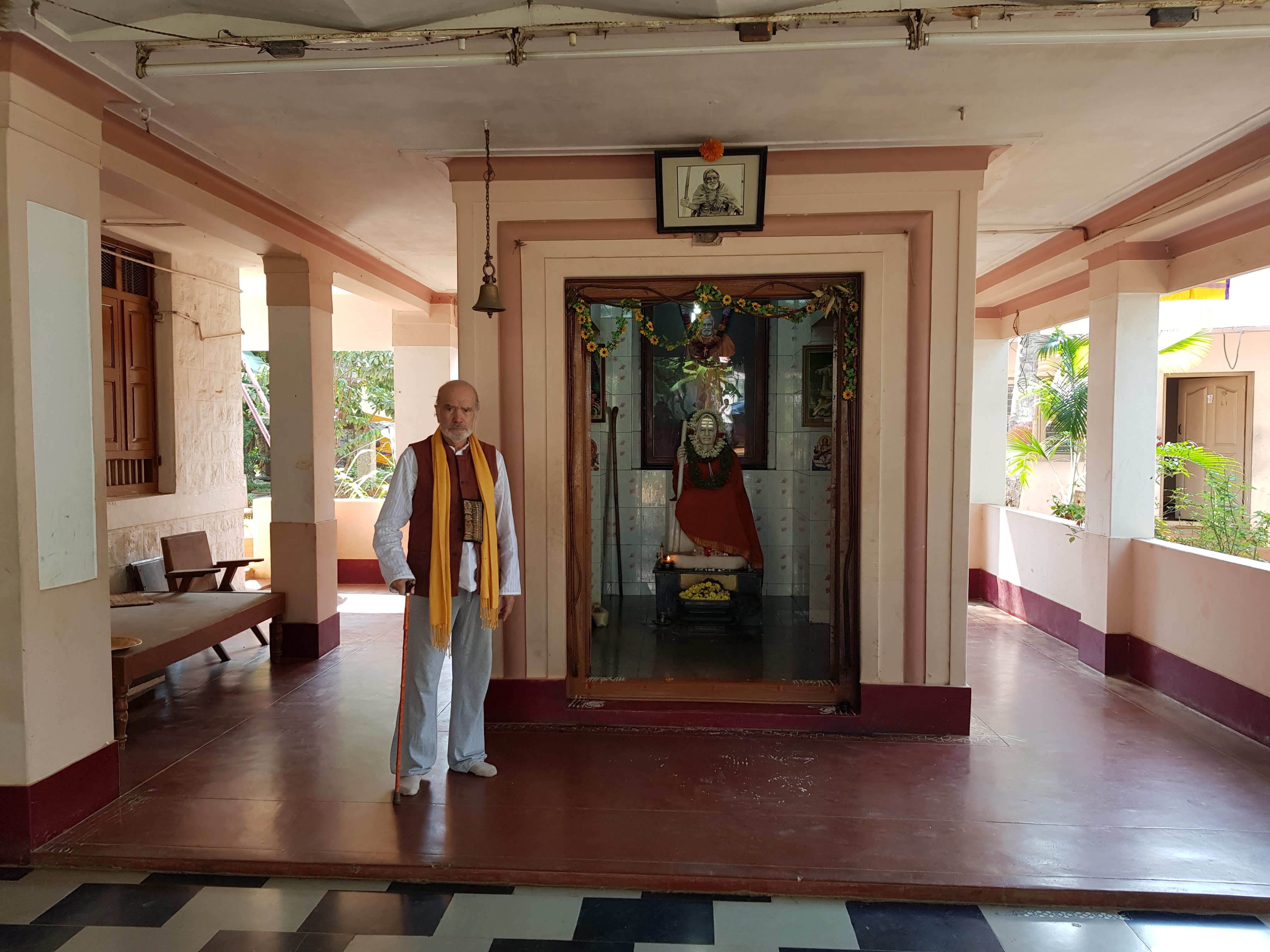
Next day, Monday, it was decided to visit Holenarsipur, a village about 1½ hour from Bangalore, where the main centre or karyalaya had been built, as it was detailed in part 4 of this travelogue. First, our taxi driver and friend (by now) Ravi, drove us to the house of a second Ravi, the one who is in charge of the first karyala of Bangalore. The latter presented us to his wife – both of them living in a comfortable and well-furnished house – and had tea along with a congenial conversation, where we talked about our country, Spain, and the circumstances that brought us to India. I congratulated the lady of the house for her good taste and the beauty of her two daughters (we only saw them in two photographs on the wall of the room where we were sitting – that is, the sitting-room). After one hour or so, we proceeded to Holenarsipur on a fairly narrow road not lacking a number of not-quite threatening shallow pot-holes and medium to small-sized stones. To our driver, Ravi, this was normalcy itself. Continue reading
Shankara and Mind
In his comments on the post ‘SamAdhi Again (Part 2)‘, Venkat said: “Dayananda has nothing useful to say about realisation. All of his statements are his mundane interpretations that don’t reconcile to anything that the great masters from Gaudapada and Sankara have said.”
And “Could you provide a couple of quotes from Sankara to support your Dayananda comment:
“Therefore, the knowledge is that I am thoughtfree (nirvikalpa) in spite of the experience of vikalpa . . . mithyA is not a problem – it is useful; mind is useful and that is all there is to it””
This attitude was also supported by Shishya in his comment on the same post: “I think Venkat put it very well.”
Accordingly, I have collected together a number of quotations that support the contention that only knowledge (and not action or samAdhi etc.) produces enlightenment; that ‘enlightenment’ is nothing other than Self-knowledge arising in the mind; and that the mind continues after enlightenment. These quotations demonstrate that those readers who have been criticising Swami Dayananda and his followers have been doing so unjustly.
*****
A. Bhagavad Gita bhASya
2.21
“(Similarly) the same Self, which is in reality beyond all changes of state, is called ‘enlightened’ on account of discriminative knowledge separating the Self from the not-self, even though such knowledge is only a modification of the mind and illusory in character (and implies no real change of state).
2.56
“Moreover that monk (i.e. man of realization) is then called a man of steady wisdom; when his mind is unperturbed; when his mind is unperturbed by the sorrows that come on the physical or other planes; …and has gone beyond attachment, fear and anger.
and BG 2.55 says that a stitha praj~na is a man who drives away all desires that crop up in the mind. Continue reading
samAdhi Again – 3
 Many misconceptions and misunderstandings appear to be prevailing about Yoga and samAdhi in Advaita. We shall take up in this Part of our Series, an assortment of those topics in no particular order and examine the possible correct position.
1. Yoga Terminology in Advaita:
The Sanskrit root “yuj” being common to words like ‘yoga, yukti etc. indicative of a union, we find that the Yoga terminology by itself is not an anathema for Advaita. The word “Yoga” appears in as many as 10 brahma sUtra-s (e.g. 1.1.19; 1.1.31; 2.1.3; 2.2.9; 3.1.26; 3.4.41; 4.2.17; 4.2.21 etc.). It is used 93 times with different meanings in Bhagavad-Gita. kaTha and svetAsvatara Upanishads too refer to ‘yoga’ practices and the latter particularly holds special praise for ‘yoga’ techniques. Shankara himself extols the effectiveness of practicing Yoga in his commentary at brahma sUtra (BS) 1.3.33.
Patanjali Yoga sUtra # 3 explains samAdhi as:
तदा द्रष्टुः स्वरूपेऽवस्थानम् ॥ – sUtra # 3, samAdhi pAda.
[tadA draShTuH svarUpe ‘ vasthAnam]
Meaning: For then (i.e. for samAdhi) finding our seeing principle entails insight into our own nature. Continue reading
Trip to India – Part 5
smartcapture
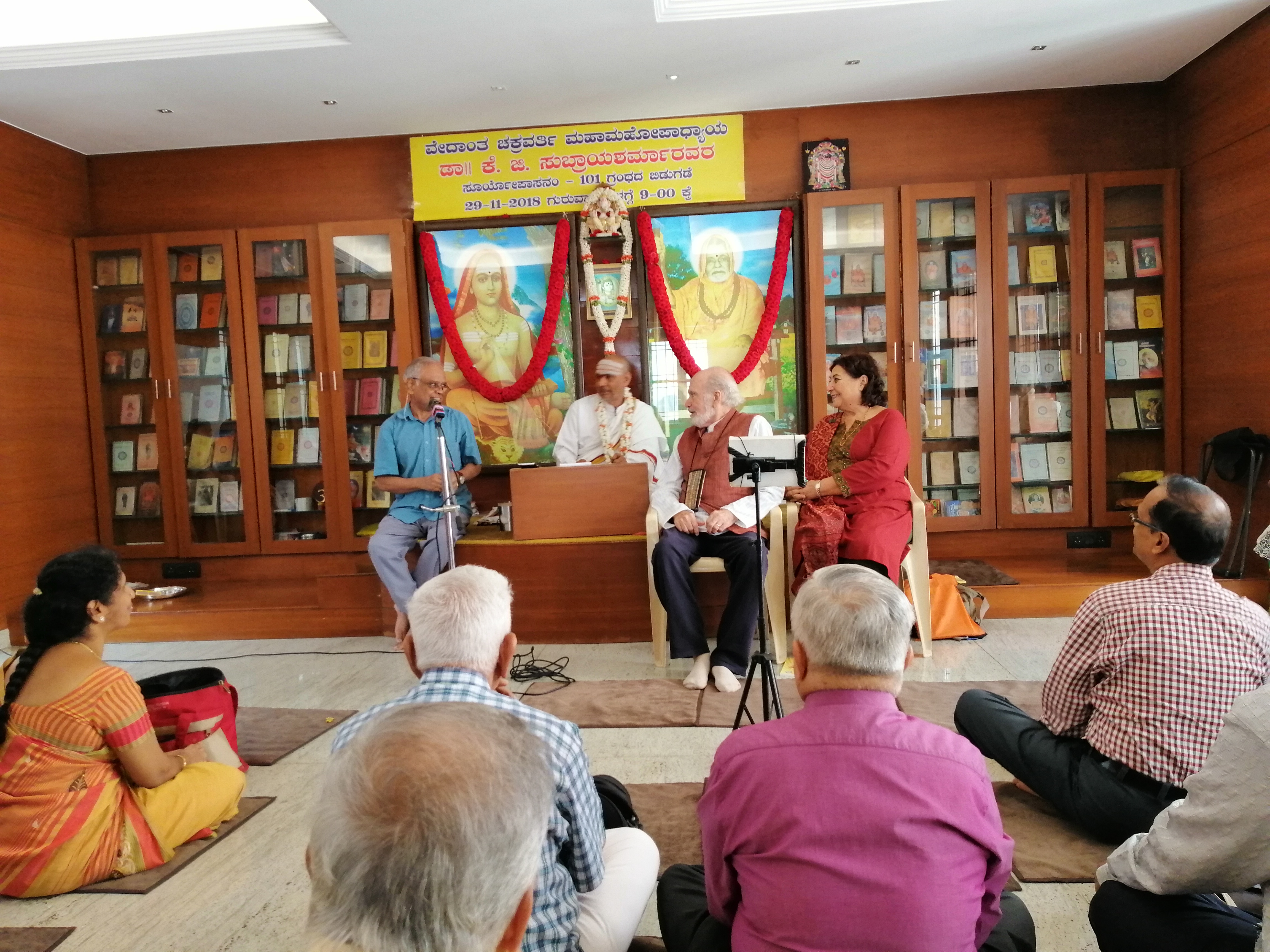
Wife, Sowmya, and a friend of the latter employed themselves the next day mostly shopping (goodness knows what they shopped – I think my wife bought a shalwar chameez). I stayed home, mostly sipping warm lassy. The following day (Saturday) my wife was taken by Ravi (our taxi driver) to visit two temples and she took some photos. Next day – Sunday – we all went to the karyalaya, centre of activities of Sw. Subraya Sharma. A large group of students, both young and adult, were sitting around in the large room – as they do every Sunday – to study Advaita Vedanta under the direction of Subraya Sharma. They all speak Kannada (definitely better than they do English, at least to my ear), so no problem. Continue reading
Three Qs & answers
Three questions & answers
 Three Q/A from QUORA (on brain, philosophy, QM, NDE, consciousness)
- How does the brain understand philosophy?
M. The brain… understanding philosophy? My reply to this is similar to the one I gave recently to another question and which was based on Socrates’ answer to an observation that someone was making. The man saw a pool of water being stirred by a stick held by a man and said that the stick was stirring the water. To which Socrates replied: ‘Is it the stick, or the man moving the stick?’ (Which one is the real agent – the material, or the instrumental cause, in Aristotelian terms?).
Equally, is it the brain, or the mind which ‘moves’ the brain which moves the stick which stirs the water?
Is it the brain, or the mind which (using the brain as an instrument) understands philosophy?
Actually, it is consciousness (as a substrate) using the mind using the brain… Consciousness itself does not do anything.
samAdhi Again – 2
 We shall present in this Part – 2 how the word samAdhi is used in Yogavasishta (Yogavasishta is available as a pdf at this site). The word samAdhi occurs very ubiquitously in this text. It is used both in its Yogic and Advaita Vedanta meaning. A few select citations are illustrated below.
[We may, however, note that the original Commentator Shri Anandabodehndhra Swami Ji and also the current author Shri K. V. Krishna Murthy whose version is followed here belong to the tradition of Shankara. Hence we can expect the influence of Shankara in their interpretation.]
***
1. samAdhi is obtained through the practice of controlling the mind. Control of the mind can help to bring about the arresting of the senses from running after the worldly objects. So the Yogi’s desires for worldly things may disappear. Unless one realizes that all percepts are unreal and non-existent, practicing only samAdhi will not stop the yogi from going back to the worldly things when he is out of samAdhi. Just being in samAdhi will not bring about the knowledge that the visible world is untrue. It is necessary that one has to realize the false appearance of the world in order to be liberated. So one cannot attain liberation from the practice of deep meditation alone. It requires the Knowledge of Self.”
– Way to Attain The Self-Knowledge, Ch 3, Origination. Continue reading