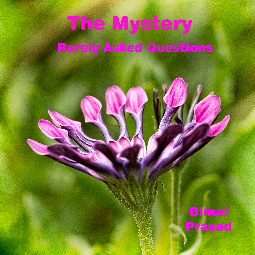
The Mystery – Part 7

Concluding this short series presenting the booklet by Bimal Prasad, in which he answers some ‘Rarely Asked Questions’ on Life. Primarily from the perspective of Advaita, questions addressed include the nature of happiness, consciousness, mind and ego. There is also practical guidance on meditation in this final chapter. Answers are relevant and succinct, so that many of the issues of interest to the seeker are covered.

This seventh and final part looks at the techniques and benefits of meditation for the spiritual seeker. See the Contents List or go straight to Part 7 of the series.

The complete (electronic form) booklet may also be purchased from Amazon.

Dr Sastry Memorial Lecture on the Vedas

Dr. Subhanu Saxena posted the following message at one of the online fora. It has a link to a 1:30:41 duration Video where one can watch a demo of Vedic recitation and the meaning of the mantras.

Message from Subhanu:

“We recently gave the inaugural memorial lecture for our dear departed Dr Satyanarayana Shastri, a great Sanskrit and Veda scholar who did much to promote the study of Sanskrit, Veda and Vedanta. The event was organized at the Bharatiya Vidya Bhavan London last Sunday and together with my Gurus from Mattur we gave a very brief overview of the Vedas to provoke interest and inspire people to take up the study of our ancient traditions. The lecture is given below and the Q&A will be posted shortly. We hope you enjoy the talk. Please feel free to share it with anybody who you believe can benefit from it
Thanks and regards
Subhanu ”

https://www.youtube.com/watch?v=vyJsZvZ4uiA&feature=youtu.be

Mulavidya – Real or Unreal? ll

Claim against Swamiji (SSS)
 Big fuss on whether avidya =mAyA
·           Swamiji does not like tarka or reasoning
·           Swamiji does not admit of avidyA in deep sleep
·           Swamiji does not endorse prakarana works, as he says they are not written by Shankara
·           Swamiji claims no role for bhakti in the advaita tradition
·           Swamiji does not accept that an enlightened soul may still suffer the consequences of past deeds
·           Swamiji advocates learning from books only, and being self taught without a teacher
·           Swamiji overuses the phrase adhyAropa-apavAda giving the impression it his discovery
·           Swamiji is not of the tradition
·           Swamiji claims he is right and everyone else is wrong

Continue reading

Overview of Western Philosophy – Part 6

(Read Part 5 of the series.)

Science

The age of increasing importance of science is usually claimed to have begun with Copernicus in the early 16th Century when he argued that the sun is the centre of the solar system and not the earth as the church had always insisted. (This is stated in the Psalms of the Old Testament and by the Greek astronomer Ptolemy in the 2nd Century.) In fact, so afraid was Copernicus of incurring the wrath of the clergy that publication of his beliefs did not take place until after his death. Even Galileo, later confirming the facts by telescope, was forced to deny it since he wished to stay alive. Galileo advocated that all prior beliefs and opinion should be kept out of scientific observation, which should be completely objective. Needless to say, once such ideas gained support, the authority of the church began to diminish and their dogmatic pronouncements about the nature of everything began to be supplanted by more tentative suggestions based upon specific observation and experiment.

Isaac Newton was born in the same year that Galileo died and his discoveries were to have a devastating effect on religious faith. Once it became accepted that the workings of the universe could be understood through scientific laws, the idea of a divine creation became suspect. Man was just a tiny phenomenon in a vast universe, no longer the centre of everything. This had a profound effect upon man’s self-image and outlook. Previously it had been believed that our earth was effectively the creation and that man was the most important being in it, capable of communing with God and aspiring to union with Him. Henceforth it became increasingly apparent that the earth was insignificant in the immensity of the universe and the concomitant conclusion was that man himself was nowhere near so important as had previously been supposed. Continue reading

Understanding Reality

Understanding Reality
in the Vision of Advaita Vedānta

by Wolfgang P., wpl@gmx.net

We, as human beings, are interested in reality. Unlike animals, we are able to ask questions about the nature of our experience. We understand that experiences are numerous and fleeting, so the question arises: What is the reality behind those experiences? From this question subsequent ones emerge: What does it mean to say something is ‘real’ or ‘unreal’? What is the nature of reality? Vedānta is a body of knowledge to analyze the nature of reality and its relationship to the individual (jīva). It applies a teaching methodology that has been handed down from teacher to student since time immemorial. The aim of Vedānta is to make one understand its fundamental tenet:1

ब्रह्म सत्यं जगत् मिथ्या जीवो ब्रह्मैव नापरः

brahma satyaṃ jagat mithyā jīvo brahmaiva nāparaḥ

Brahman is the only truth (satyam), the world, jagat, is unreal (mithyā), and there is ultimately no difference between brahman and the individual self (jīva).

In this article I will explain the three categories Vedānta provides to understand reality: sat or satyam, asat, and mithyā.2 When we talk about reality, we need to distinguish that-which-is-real from that-which-is-not-real. This discriminative inquiry is called tattva-viveka. In Sanskrit, that-which-is-real is called satyam, whereas that-which-is-not-real is called asat. Continue reading

Advaita Vedanta – A Long Lost Tradition Revived

The terms  ‘Vedanta’ and ‘Advaita Vedanta’ are used loosely nowadays to describe teachings whose principles do not factually meet the subtlety within the profound truth of  ‘One-without-a-second’ or ‘There is only the Absolute.’ If this principle is corrupted or compromised then guidance to the truth can be affected from the beginning, which may in turn lead to an incomplete realisation. Alternatively, we may only hear statements describing the highest (Paramarthika) Reality without any means at our disposal for approaching such a Truth.

Being the foundation of its teaching, the principle of Advaita need not be compromised in allowing for the ‘mundane’, empirical experience of the seeker and the questions stemming from his or her experience – the entire Vedic system naturally accounts for development at all stages of life and Vedanta gives an understanding of the exact status of the world, as we experience it, in relation to Reality. Continue reading

Natural State and UG

Uppaluri Gopala Krishnamurti or more popularly known as UG was a “philosopher, a Non-guru, guru.”  Though he used to claim “that the demand for enlightenment was the only thing standing in the way of enlightenment itself,”  his close followers consider him to be a jIvanmukta. Krishnamurti himself often “referred to his state of being as the ‘natural state’.” Anon who is a frequent Commentator at this site contributes the following write up about UG’s natural state — ramesam.]

UG Anon writes:

For me to do a commentary on what U.G. has described as ‘The Natural State’, would be a very difficult thing as I would only be playing with ideas and concepts about what someone else has said, much like doing a commentary about what the Upanishads described. The closest thing would be to paraphrase some of the descriptions from what U.G. had said about it. Here is my feeble attempt:

UG makes a clear distinction between ‘states of mind’ and what happened to him. He refers to the totality of mind and all its maneuvering as having nothing to do with the ‘Natural State’. He made it clear that if anything had to be done, it was the stopping, not volitionally, of all attempts to gaining ‘understanding’, Continue reading

Mulavidya – Real or Unreal? – I

INTRODUCTION

As S.K. Ramachandra Rao relates in his Introduction to Sw. Satchidanandendra’s book ‘Salient Features of Shankara’s Vedanta’ ( a translation of ‘Shankara-Vedanta-Prakriye’ in Kannada language), the Swami decided to find out for himself what the real tradition of Shankara and the latter’s contributions to it had been, since he had suspected for some time that the former had been misrepresented by later advaitins. This desire took form in the way of a monograph he wrote in Sanscrit in 1929 with the title of ‘Mulavidya -nirasa. ‘He applied himself diligently to repeated study of Shankara’s works (Bhashyas on the three Prasthanas) for several years to convince himself that the sub-commentaries (of Vacaspaty Misra and Padmapada) had not done justice to the great master… It was in the year 1920, a year after his wife passed away, that he felt called upon to take this as a mission in his life’. Continue reading

The Natural State

folds in sheet  Q:  “How to stop thinking?”

I do not know what this struggle about “stopping thought” is.

Everyone from the most intelligent to the dullest does it several times each night in deep sleep without any effort whatsoever!

It happens all the time when you are stunned by something sudden — a surprise, a life-threatening or life-enhancing situation, a beautiful object (person, scene, painting, art), in love.

Secondly, the world itself is a mentation (thought) — remember, the world includes your body-mind, mental thought etc.

Also, have you not observed that breath is closely related to thought — slow down breath, thoughts slow down; end breathing totally and thought ends – but that is called ‘death’ often. 🙂

Q:   Thought is more or less running my life, instead of me just being…”

There is a subtle but a great mis-understanding in that statement. Continue reading