Non-dual Reality – Q. 328

Q: Can one ever KNOW that reality is non-dual?

A (Ramesam):

(i)   YES, The moment you can grasp tight your reflection in the mirror!!! 
(ii)  No, you cannot know it like you know the salary you get.

(iii) Yes, you cannot ever NOT know it; what all IS, is your perception alone.
(iv)  No, if you place yourself aloof trying to know it as a distant object.

(v)  Yes, you know It in your deep sleep.
(vi)  No, if you want to measure and compare to duality. Continue reading

Can you accept that the world is mithyā? – 2/2

Read Part 1

It is extremely difficult to accept that what we see, what we experience, what we take to be real is not quite real. Even Swami Dayananda wrote of his utter shock on realising that the solid universe is made up of nothing but words and meanings. I personally remember the first time I saw his demonstration of close-up magic when he held up a clay tea cup in the meeting hall, one hot afternoon in his Gurukulam in Anaikatti. “What am I holding?” he asked and then answered for us: “You say cup, I say clay. Tell me which bit of this is cup? My fingers touch clay, the weight of what you call cup is the weight of clay. The feel of the cup is the feel of clay. The colour of the cup is the colour of clay. Where is the cup? Is it on the clay? If it is I can remove it. Maybe it is in the clay?” In this way, as we watched, the thing called ‘cup’ vanished in front of our very eyes. ‘Cup’ is nothing but the name given to a particular form of clay for the sake of distinguishing it from other things made of clay and all other things as well.

Now extend this to all objects that can be traced back to a common cause: even science supports this view. Then at each stage we just have names: Shirt is the name of a form of material, material is the name of yarn, yarn of cotton, cotton of fibres, fibres of atoms, atoms of sub-atomic particles, etc till we arrive at a single cause. (Vedānta śāstram goes one step further than science in stepping from the perceptible to the non-perceptible world.) Continue reading

Enjoying Being Brahman – Q. 324

Q1: When I was in the constant of awareness that I was Brahman I used to enjoy the Thoughts that all indeed was Brahman. Since I progressed to the simply I AM I am not enjoying the earlier feelings of thinking everything as Brahman. Is it that the state of being in simply I AM is absolute absence of any thought whatsoever? 

 Q2: How to overcome the sleep state to be in constant awareness of Who am I? Please some practical hints!

 Regarding my second point I intended to know more about the Fourth State in which the Saints wait to consume all their Prarabdha. How is this state practised and what are the skills of it?

Please shed some light on how do the realised but unpractised people live in their day to life while all the time immersed in their truest identity. My readings tell me just to let things happen without least botheration how they happen. Is it this way?

A (Peter): These questions make a strong case for why seeking proper guidance in this work is vital. Vedānta isn’t something that anyone can just pick up from a book, any more than anyone can dive straight into advanced mathematics from a book. If one doesn’t have a basic concept of numbers and the ways they combine through addition, multiplication, subtraction and division then how could one cope with the more esoteric realms of the subject? And compared to the science of self-knowledge, which is subtler than the subtlest, higher maths is crude. Self-knowledge needs appropriate prep work before the books make sense. Continue reading

Experience and Knowledge (Q. 321)

Q: ‘Experiential’, seemingly, is becoming a stumbling block in current discussions within spirituality and non-duality. There are the ‘experiential’, usually ‘anti-intellectual’ types (who deprecate ‘merely intellectual’, or ‘conceptual’ approaches), and those who defend the proper use of mind and the intellect, without denying the validity of experience.

 Would it be possible, though, to dispense with either of the two concepts: ‘knowledge’ and ‘experience’?; they appear to overlap, practically being synonyms and, indeed, one can say “I know pain in the belly”, or, “I know such and such emotion”, “I know (I am acquainted with) life”, etc., without resorting to the word ‘experience’ – the word ‘acquaint’, conveniently, is derived from the Latin via old French: cognoscere, gnoscere. The other alternative would be to dispense with the word ‘knowledge’ and use instead ‘real’/’unreal’, ‘reality’, which is, precisely, sat/asat in sanskrit – and expressions using these terms are quite frequent, as everybody… realizes (‘is cognizant with’, then, would have to be ruled out). Just today I wrote in a comment that true understanding is an experience, but now I have my doubts. Ultimately, certainly, the only Experiencer/Knower is brahman/atman (though he remains ever unmoved). Continue reading

Vision Of Truth (sad darshanam – 2)

Verse 1 continued…


Ramana Maharshi then puts down a question; “How can we remember this un objectifiable, one truth”.  He goes on to answer in the same breath. Remembering it is abiding in it as one’s own self.

ABIDANCE itself is REMEMBRANCE. One cannot remember it as an object. Remembering is a thought; remembering constantly is repeated thought; forgetting is also a thought. The self is not an object of remembrance and forgetfulness. The constant abidance in it as non different from one’s own self is real remembrance.

It is not mentally repeating “I am Brahman”. Instead it is a firm, unshakeable conviction of one’s own true identity. Come what may, objective experiences, within and without keep changing but the truth is apprehended as is. If there is repetition of words in the form of remembrance then it is a mind- based transaction. Any mind based transaction has a beginning and an end (it also being an action). Hence, prior to the beginning of the action and post the action, the identity of Atma and Brahman, then, has to discontinue. If this is so, the eternality of Atma will be in question. Hence, it cannot be a mind-based transaction. Continue reading

Inception: Dream or Not?

Here are two (related) book reviews which may be of particular interest to readers of our new serialization of ‘The Dream Problem’.

Nearly 2 years ago, the film of the moment was ‘Inception’, directed by Christopher Nolan. And this justifiably went on to win four Academy Awards. Friends told me how good this film was but, as is quite normal regarding films, I did not actually get to see it until some time after it came out on DVD. Since I have been a fan of science fiction ever since my childhood, I realized fairly quickly what this film was about in a general sense. Nevertheless, it was obvious that the story was quite complex and that all of the nuances could never be fully appreciated with one viewing. Accordingly, even at the time, I wondered whether anyone would write a book about it. (Of course, I realized that there would be a deluge of blogs on the subject but there is the slight problem of not having sufficient time to look, as well as not knowing which ones would be worth reading.) Continue reading

Gunas and History (Q. 318)

Q: 1. If the triple gunas are the matrix of the “reality”, aren’t they immutable and therefore truly real? (I have asked this question a while ago in our personal correspondence but I can’t access my old email and it still bothers me…).

2. What is the ontological status of the course of human history? Is it objective, or just a sort of shared mass illusion that somewhat gets transferred from generation to generation? I am aware of the imprecision of my language but hopefully you will understand my meaning.

A to Q1 (Peter)Guṇas are the subtlest form of manifest matter and, being matter, are thus subject to change. So they are not immutable.

 Guṇas in their unmanifest and undifferentiated form are the triple śakti of māyā: jñạna, krīyā and dravya shakti, the undifferentiated and unmanifest powers of knowledge, action and materialisation. When these move into manifestation they get the names sattva, rajas and tamas. Continue reading

Vision Of Truth (sad darshanam) – 1

Ramana Maharshi was one of the greatest philosophers India has seen. One does not need an introduction as much has already been written about him.

He used to direct people to the nature of I, not as the body mind individuality but the very aware-full being. He would relentlessly ask his followers to enquire into the individuality by probing into the innermost recesses with a ‘Who am I’ thought.

This ‘who am I’ should not be taken as a mental, mechanical repetition. Knowledge will not dawn on a person, by forcefully exterminating thoughts and contemplating on ‘Who am I’. Man has become habituated to identifying with the body mind and ‘who am I’ enquiry by an unprepared mind will lead one nowhere.

It can provide a temporary tranquility which can be got even through listening to good music or visiting a hill station. This ‘who am I’ is nothing but claiming the content of our very being as the only truth by negating all that one is not. Once the non self is negated, there is nothing to do. The truth is apprehended as one’s own self. His advice hence was not to get lost in unnecessary thoughts and questionnaires but know oneself, as the truth behind the very ego, the individuality which he thinks he is. One is not the ego, but the very truth behind it.

Continue reading

ANESTHESIA, DEEP SLEEP, DEATH AND CONSCIOUSNESS – Part 3/3

[Part 1/3         Part 2/3]

To eff the ineffable:

We travelled the depths of Non-duality in Part 2/3.

As Jeff would put it, “I am realized, you are not” is a silly game. There’s no one – none – that’s not Brahman. You are already realized! So relax.

And let’s know what the brainy brain-scientists say consciousness is.

What consciousness is and how the brain produces it (if it does), is still one of the great challenges to science. Until a few decades ago, science was averse to dabble into this subject for lack of adequate investigative tools (both conceptual and instrumental). “Today consciousness research has become a passion for many scientists.”

But what is consciousness? It’s like asking what life is or what energy is. You know it when you see it. We say that “a brain that is fully awake and constructing experiences is fully conscious.” The thalamus, a sort of hub located deep in the brain for information flows from the senses to the upper reaches of the brain is crucial for consciousness. A person turns into a vegetative state if the thalamus is damaged or the information flows are inhibited. This does not mean that thalamus produces consciousness; it may just show that one is conscious – much like a thermometer which doesn’t actually make the heat, but tells you how hot it is.

Dr.Giulio Tononi of the University of Wisconsin–Madison and his colleagues are studying

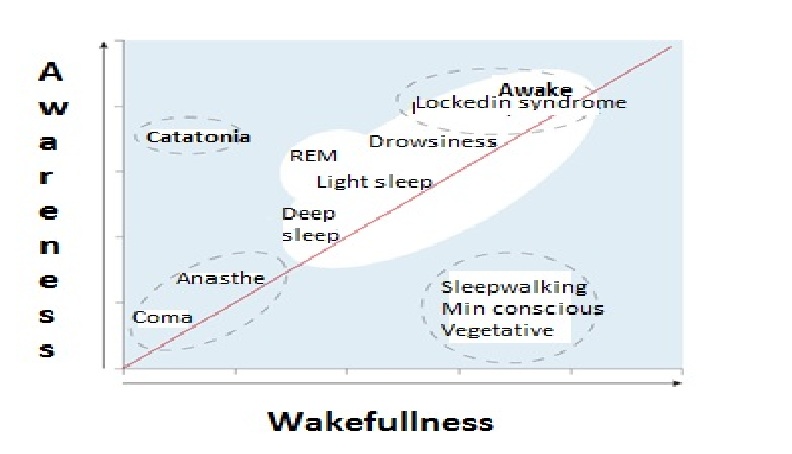
States of consciousness (After L. Saunders, 2012)

brains that are deeply asleep, under anesthesia or in comas to understand consciousness. As shown in the figure at the right, “awareness typically tracks with wakefulness — especially in normal states of consciousness. People in coma or under general anesthesia score low on both measures, appearing asleep with no signs of awareness. Sometimes, wakefulness and awareness become uncoupled, Continue reading