
What is Brahman? (Part 1)

Enlightenment is the realization in the mind of a person that ‘I am Brahman’. So what is this ‘Brahman’ that I am supposed to realize? Knowing this must constitute a significant aspect of the Self-knowledge that I need to acquire in order to become enlightened.


(The following analysis is loosely based upon Swami Paramarthananda’s talks on Shankara’s bhAShya [analytical commentary] on the Brahma Sutra.)

Before we can investigate anything, two criteria must be satisfied:

1) We must know what it is we are investigating (a definition)

2) We must have an appropriate means of acquiring data (a pramANa). Continue reading

Belief – a dangerous thing

Belief can be a dangerous thing, as Galileo discovered to his dismay early in the 17th century, when he was denounced to the Inquisition because of his claim that the earth went around the sun and not vice versa. Unfortunately for him, the Catholic Church was committed to the opposite belief so he never stood a chance. Nowadays, of course, we know better and happily acknowledge that Galileo was correct, despite the fact that everyone still talks about sunrise and sunset!

(Incidentally, this is a frequently encountered metaphor for the change that occurs upon self-realization. Just as we recognize the truth of heliocentricity, yet still talk as if the Sun revolved around the Earth, so the realized man still acts as though he lives in a dualistic world, even though he now knows that everything is Brahman.)

Belief is so often treated by the believer as if it were true knowledge, instead of simply a strongly (and often wrongly!) held opinion. We really ought to know better, given the history of such mistaken, scientific views as the theories of phlogiston and ether. If the most brilliant scientists can be wrong, so can we! Continue reading

Knowledge and the Fruit of Knowledge

OLYMPUS DIGITAL CAMERAFollowing on from the l-o-n-g discussion we had on this topic under the thread ‘akhaNDAkAra vRRitti – The End of Suffering‘, I have written what was intended to be the commentary on kArikA 3.40 in my next book (OM: Waking Dreams… and Reality), which covers the essence of this discussion. I have decided that I will probably simplify this considerably for the book, because it is intended to be an accessible and readable book, rather than an academic one. But, because of its relevance, I am posting the entire section, as first written, below.

You now know all about adhyAropa and apavAda and acknowledge that all of the teaching is only interim, to be used to lead us to the final understanding and then discarded. The corollary to this is that, in principle at least, any teaching could be used for this purpose. If it works, it is valid. So it is hardly surprising that there are other methodologies altogether, which can have the same ultimate purport, e.g. Zen Buddhism, Taoism, Kabbalah etc. (I don’t have any personal knowledge of these other systems but understand that their essential teaching is non-dual.)

As far as Advaita Vedanta is concerned, the finer details of the teaching differed from one teacher or branch to another, both before and after Shankara. And some modern-day proponents tend to adhere to some elements and some to others that are apparently contradictory. None of this matters in the final analysis but does tend to lead to some quite heated discussions on the Internet! Continue reading

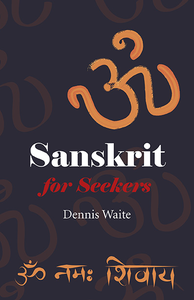
Sanskrit for Seekers

sanskrit_for_seekers

Since you are reading this blog, you are presumably a spiritual seeker interested in Advaita. It is also very probable that your knowledge of Sanskrit is minimal or non-existent. I receive occasional complaints about the use of ITRANS – the transliterated ‘English’ form of Sanskrit words – so even that causes problems for many, let alone the original script (called Devanagari) which Sanskrit uses. So why would you want to learn anything at all about the language? Well, if you really are interested in Advaita (or Buddhism, if it comes to that), it is a fact of life that most of the original material from which these teachings derive was written in Sanskrit. Without any knowledge of the language, without even the ability to look up a word in a dictionary, you are forced to rely upon the abilities, and the integrity, of whichever author happened to ‘translate’ the original text on which he or she is commenting. I am currently writing a book on the Mandukya Upanishad and Gaudapada kArikA-s, and this has involved me in referencing many different translations of the original text. [Note that this is a good example why you need to know some Sanskrit. The word kArikA means ‘a verse, commentary or treatise’ but if you ignore the capitals and write this as ‘karika’, it means ‘an elephant’!] And it would amaze you how it is possible to render quite different meanings. Whether this is because of language ability or because the author has a vested interest in propagating a particular point of view is not always possible to say. What I can say, is that is essential to be able to check specific words from time to time to ensure one gleans original intent rather than a modern, possibly biased interpretation. And, before I continue, here is a confession from the introduction to the book: Continue reading

More on ekajIva vAda

Rather than add more comments to the ‘mokSha for All’ thread, I thought it better to make this a separate post. It is the same topic but here I posed a question to AchArya Dr. Sadananda of Chinmaya Mission, Washington, whom I have known for a long time. I have interposed comments in his response and his follow-up comments have been added in green.

Dennis:

 Obviously any statement about the ‘nature’ of absolute  reality can only be made from the jIva’s standpoint; i.e. an  ‘as though’ pAramArthika statement made in vyavahAra. Thus, any talk about a world is clearly a vyAvahArika statement;  aham brahmAsmi is an ‘as though’ pAramArthika statement.

Sada:

Dennis – aham brahmaasmi is statement of understanding of the truth – it is recognition of that paaramaarthika state but expressed using the instruments available in vyavhaaha that is the BMI. It is not just vyaavahaarika statement about paramaarthika state. It is like when I say sugar is sweet – it is statement which may not mean much to a listener who may not know what sweetness means, but it means a lot to one who knows and is the statement born of direct experiential understanding – or aparoxaanubhuti. Continue reading

Some Thoughts And Questions On ‘mokSha for all’

Our last ‘Thoughts and Questions’ proved so popular that we are offering a new topic for your consideration:

I received an interesting Question that touches on several aspects of creation and liberation for ‘everyone’. I posted the question at Advaitin discussion group because of my doubt about its value in gaining Self-Knowledge which is after all the one that matters for us here. The question is this:

“Is there any teaching anywhere in the scriptures regarding the enlightenment and ‘freeing’ of all jIva-s? What the questioner is getting at is: will the cycle of sRRiShTi – sthiti – laya ever come to an end, namely when there are no more jIva-s left to be enlightened? Or even: if this does occur at some point, will the process start all over again with a new set of jIva-s? If not, what happens then?”

My initial apprehension was that any ‘answer’ is clearly going to be in the same category as the various creation myths that we can find scattered about in the scriptures. However, a lively discussion ensued that eventually led to eka jIva vAda, a powerful but contentious theory that describes liberation of the jIva and the simultaneous end of creation.

I give below some of the salient points that have come up in those discussions: Continue reading

Difference

differenceVive la difference!

I am still in the process of writing my next book on the Mandukya Upanishad and kArikA-s. I have just written the following section on the concept of ‘difference’. Since I posted a query to the Advaitin group, relating to what Swami Paramarthananda had said on the topic, I concluded by sending the completed section to the group. Accordingly, I am also posting this here.

In his commentary on this kArikA (2.34), Shankara touches on the logic of this concept of ‘difference’ and Swami Paramarthananda expands upon this. What, he asks provocatively, is the color of the difference between red and blue? Clearly, it is potentially a very important topic since, if it could be proven logically that the idea of ‘difference’ is incoherent on examination, it would effectively demonstrate the non-dual nature of reality. Numerous post-Shankara philosophers have looked into this and formulated involved arguments. There is extensive material in the post-Shankara texts of brahmasiddhi, iShTasiddhi, tattvashuddhi, khaNDanakhaNDakhAdya and chitsukhI/tattvadIpikA but, having looked at these, they seem too impenetrable to study in detail. (No references are given for these – you really don’t want to read them!) Continue reading

Why Advaita Works

To explore the womb, or tomb, or dreams; all these are usual

Pastimes and drugs, and features of the press:

And always will be, some of them especially

When there is distress of nations and perplexity

Whether on the shores of Asia, or in the Edgware Road. (T. S. Eliot. Four Quartets, 3.5)

If you are reading this magazine*, I suggest that there is a high probability that you are not happy! It is an undeniable fact that the majority of people today are dissatisfied with what they perceive as being a mediocre existence. They may feel that they are limited by an unattractive and illness-prone body or by a mind that is imperfectly educated and unable to make intellectual leaps of understanding. There are very many things that we want – objects, partners, lifestyle, jobs etc – but few that we seem to be able to obtain. (And, even when we do obtain them, their rewards are invariably ephemeral.) Western society relies upon the media advertising all of these things, and thereby continually reinforcing the desires. Being repeatedly frustrated by this materialistic lifestyle, it should be hardly surprising that many turn towards the spiritual in the hope that this might bring about peace and a durable happiness. Continue reading

Origin and Meaning of the word mithyA

mithya_head

Seekers often ask questions about the meaning of the word mithyA. It is, after all, one of the most important concepts in Advaita. Someone has just asked about the usage of the word itself: Did Shankara use it? Does it occur in the Upanishads? I had to do a bit of research on this one and thought others might be interested in what I discovered.

The dictionary definition of the word gives: 1) contrarily, incorrectly, wrongly, improperly; 2) falsely, deceitfully, untruly; 3) not in reality, only apparently; 4) to no purpose, fruitlessly, in vain. According to John Grimes, it derives from the verb-root mith, meaning ‘to dispute angrily, altercate’.

It seems that it only occurs in one Upanishad – the muktikopaniShad. This is the Upanishad which tells you which Upanishads you need to study in order to obtain mokSha or mukti. It says that you can, in theory, get away with studying only one – the Mandukya, with its bare 12 sutras. If this alone does not enlighten you, then you need to study the 10 major Upanishads (Isha, Kena, Katha, Prashna, Mundaka, Mandukya, Taittiriya, Aitareya, Chandogya and Brihadaranyaka). If you still haven’t got it, there are a further 22 making up the main ones. Failing that, you are doomed to have to study the 108 commonly recognized ones. (After that, you start again!) Continue reading

Q.345 – The Purpose of Life, part 5

Go to Dhanya’s answer to this question

Part 5 – Dennis’ answer to this question

Q345: What is the purpose of life?

 If, as stated in Advaita, we are actually in a state of sat-chit-Ananda and we are actually this ‘Self’ already, why have these ‘illusions’ and this ‘ignorance’?

 How can we believe in lila? What could be its purpose? There is no convincing answer – I am sure you will concur.

This then raises my more fundamental query. This ‘Self’ on which reams have been written – what is the proof that such a ’Self’ exists?

 The root problem is that in the end, even Advaitic teachings finally rely on ‘blind faith’ to put their point across. There’s nothing wrong in having faith. All religions ask for blind belief in the almighty to get you your promised ‘Kingdom of God’. It’s only in Advaita that folks try to push their case by saying: “No, it’s not pure faith, it’s by reason and discourse that we reach the truth etc”.

 To quote Gaudapada in his Mandukya Upanishad kArikA, “That which is stated in the scriptures ‘and is supported by reason’ is true  and nothing else”. The ‘reason/discourse’ argument for following Advaita is pure bunkum, in my opinion. It relies on blind faith not on a deity, but in an obscure ‘Self’.

 And even if reality is non-dual, why this seeming duality? Why does this mithyA of life exist? Continue reading