Bādha

The Process of Bādha: The Engine of Realization in Advaita Vedānta

In the rigorous intellectual and spiritual framework of Advaita Vedānta, the journey toward enlightenment is not marked by the acquisition of new objects of experience, but by a fundamental shift in understanding. At the heart of this shift lies a crucial technical process known as bādha. Frequently translated into English as sublation, subration, cancellation, or negation, bādha is the cognitive mechanism by which a previously accepted point of view or understanding is superseded by a totally different, more accurate one upon the receipt of new information. It is effectively the apavāda stage of the adhyāropa-apavāda process.

For the seeker, understanding bādha is essential because it defines the very nature of Truth and Reality. In Advaita, the “Real” is defined specifically as that which cannot be sublated—that which remains uncontradicted in all three periods of time (past, present, and future).

Continue reading

Ātman and Brahman

The Pillars of Non-Dual Reality

In the vast and rigorous tradition of Advaita Vedānta, two terms stand as the absolute foundation of all spiritual inquiry: Brahman and Ātman. While these words can initially seem like abstract philosophical markers, they are, in fact, pointers to the most intimate and undeniable truths of our existence. Traditional Advaita, as systematized by the great sage Ādi Śaṅkara in the 8th century, is fundamentally a methodology designed to reveal that these two apparently different entities are, in reality, one and the same.

The core message of this teaching is famously summarized by the dictum: brahma satyam, jaganmithyā, jīvo brahmaiva nāparaḥ—”Brahman is the reality; the world is not in itself real; the individual self is none other than Brahman”. To understand this “Great Equation,” we must first clarify what is meant by these two essential terms through the lens of scriptural testimony (śabda pramāṇa) and Śaṅkara’s commentaries.

Continue reading

Adhyāsa

Explanation of key terms in Advaita – No. 2

If adhyāropa-apavāda is the most important term regarding the teaching method of Advata, adhyāsa is the most important term describing the essence of the teaching.

Adhyāsa: The Fundamental Error of Mistaken Identity

In the study of Advaita Vedānta, the term adhyāsa is arguably the most critical concept to grasp if one is to understand the human condition and the path to liberation. Often translated as “superimposition,” adhyāsa refers to the fundamental mistake of apprehending one thing as something else. It is the cognitive error of mixing up what is real (sat) with what is only apparently real (mithyā), thereby creating a sense of confusion that defines our everyday experience. This concept is so pivotal that Ādi Śaṅkara devoted the entire introduction of his commentary on the Brahmasūtras—known as the Adhyāsa Bhāṣya—to explaining its mechanics and implications.

Continue reading

Book Review: dṛg dṛśya viveka, Clarissa

Over the next couple of months, I will be posting some book reviews that I made 10+ years ago, which are no longer available elsewhere on the Internet.

The first of these is:
dṛg dṛśya viveka, Clarissa, Lulu Press, 2010, ISBN 978-1-4452-0858-9. (171 pages), $19.62 from Amazon.com. Also available from Watkins Books, 21 Cecil Court, London WC2, £12.99.

Continue reading

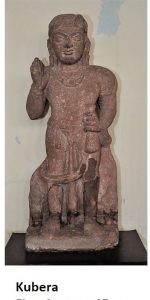
Kubera’s Search for The Self:

 [The world and everything in it are imaginary (mithya) ‘names and forms’! Therefore, tradition depicts Ishwara as a pauper because he does not possess any worldly wealth. However, he transcends the worldly objects and is said to be an embodiment of the Self. In contrast, Kubera possessed a lot of worldly treasures, a collection of mere names and forms, but lacked the real wealth of Self-knowledge. So, he sought guidance from Ishwara.]

Lord Ishwara was holding court in Kailasha. His consort and both his sons were also seated with him. There were several nobles and other gods in attendance. The gurgling flow of the Ganges from the matted hair of the Lord and the chirping of the birds and other creatures around were sounding like a background drone reciting the name of Shiva-Shiva-Shiva. The God of Riches, Kubera, famous for his wealth, came to meet Ishwara. He bowed to the Lord and worshiped him as per the tradition. Kubera had a deep philosophical question and posed the same to Ishwara requesting the Lord to relieve him from the doubt. Continue reading

pratibandha-s – part 5 of 10

Read Part 4

vij~nAna

Shankara differentiates what might be called ‘ordinary’ or ‘intellectual’ knowledge (j~nAna) from ‘transformative’ knowledge (vij~nAna). The knowledge becomes transforming – i.e. making it efficacious in conveying the status of jIvanmukti – when the gaining of it has been preceded by successful sAdhana chatuShTaya sampatti. In his bhAShya on muNDaka upaniShad 2.2.8, he says:

“Wise, discriminatory people (dhIrA) see through vij~nAna; vij~nAna is a special (vishihtena) knowledge (j~nAna), born out of the teaching of shAstra and AchArya (shAstra AchArya upadesha janitam), and received in a specially prepared mind, born (udbhutena) out of total detachment (vairAgya), having control of inner and outer organs (shama and dama), and which is therefore capable of upAsanA to begin with and later of nididhyAsana which together are called meditation (dhyAna). Through such a vij~nAna, wise people realize that the nature of the Atman (Atmatatvam) is non-different from the nature of Brahman (brahmatatvam)…” (Ref. 10)

‘Who am I?’ in communication

Who are we speaking of when we use the words ‘I’ and ‘you’ in writing and speech?

Since we are Advaitins, there are actually three possibilities:

  1. ‘I’ could mean Atman/Brahman, if used from the ‘as if’ pAramArthika viewpoint;
  2. ‘I’ could mean the reflected Consciousness (chidAbhAsa);
  3. ‘I’ could mean the usually understood ‘named person’.

Continue reading

The Chrysalis (Part 3)

Read Part 2

The sheath-related verses in the Panchadashi occur in Chapter 1:

  1. The five sheaths of the Self are those of the food, the vital air, the mind, the intellect and bliss. Enveloped in them, it forgets its real nature and becomes subject to transmigration.
  2. The gross body which is the product of the quintuplicated elements is known as the food sheath. That portion of the subtle body which is composed of the five vital airs and the five organs of action, and which is the effect of the rajas aspect of Prakriti is called the vital sheath.
  3. The doubting mind and the five sensory organs, which are the effect of Sattva, make up the mind sheath. The determining intellect and the sensory organs make up the intellect sheath.
  4. The impure Sattva which is in the causal body, along with joy and other Vrittis (mental modifications), is called the bliss sheath. Due to identification with the different sheaths, the Self assumes their respective natures.
  5. By differentiating the Self from the five sheaths through the method of distinguishing between the variable and the invariable, one can draw out one’s own Self from the five sheaths and attain the supreme Brahman.

(These are from the translation by Swami Swahananda.) Continue reading

Q. 429 Discussion on ‘I am That’

Q: I have a couple of questions about ‘I Am That’.

As I understand it, this essentially says: Atman = brahman. So the ‘I’ is not the ahaMkAra ‘I’, rather the Atman ‘I’.

1. Did I get that right?

2. When one begins to reflect upon ‘I Am That’, is one expected to feel the I as the ahaMkAra I? And then move, gradually, towards realizing the I is in fact Atman?

3. The reason I ask (2) is because I have a great deal of difficulty ‘feeling’ my ahaMkAra I. It just doesn’t ‘compute’ with me. Does this brain/body sense things, have feelings, emotions, thoughts; am I aware of external and internal things? Yes! All the time. But are these sensations, feelings, thoughts, etc. = ahaMkAra ‘I-me’? No. They’re just… stuff that happens, electrochemical dances in a brain in a skull in a body that is identified as ‘Jack’ Is this a problem – that I can’t consciously/directly feel my ahaMkAra I? That when I look for it, I see mithyA, nothing of essential substance? Could my not being able to directly experience my ahaMkAra I be a stumbling block? Continue reading

Q.379 – Practice, Enlightenment and Reincarnation

Q: My understanding is that the purpose of spiritual practice is to purify the intellect so that it ‘reflects’ Consciousness without distortion. This enables the mind to recognize the delusion caused by ahaMkAra. This would mean that ‘enlightenment’ is a function of the mind. Is this correct?

If this is so, it would seem to mean that any ‘benefits’ gained from enlightenment would only apply to this body-mind, in this life. Is this so?

Scriptures indicate that one may have to undergo many lives before gaining mokSha, and suggest that fruits of previous lives accumulate to enable this. But, if enlightenment is an event in this mind, how can previous lives be of any benefit? Is there something in the mind that is ‘carried over’ into future births?

A (Ramesam): The most fundamental aspect of Advaita teaching is that an individual (jIva) is non-different from the Supreme Self (brahman). It follows, therefore, from this that a seeker is already of the nature of ever pure, all-knowing and liberated entity. As Gaudapada explains in his kArikA on mANDUkya Upanishad, by Its own freedom, brahman takes the form of an individual (and the world) and there is neither a creation nor liberation, neither a seeker nor something to be sought. Continue reading

Who Slept Well – Part 4

This is the final part of the series from AchArya Sadananda, (only edited by myself).

Deep-Sleep State

When we go into the deep sleep state, we start withdrawing each of the kosha-s, one by one, with the desire or thought of going to sleep. The ‘I want to sleep’ thought forms the contents of the vij~nAnamaya kosha or the intellect, when it goes to sleep or when it goes into an unmanifested state.  In the process of sleeping, there is a withdrawal of each of the grosser kosha-s into the subtler ones: annamayakosha to prANamayakosha, prANamaya to manomaya, manomaya to vij~nAnamaya.  At the time of sleep, the vij~nAnamaya or intellectual sheath becomes unmanifested with all the kosha-s as part of its ingredients, but in undifferentiated form. That unmanifested state of the intellectual sheath with all its constituent kosha-s is now called Anandamayakosha, since there is absence of any discriminative thoughts and associated relationships, other than the homogeneous thought of ignorance or avidya. This is referred to as avidya vRitti.  It is, in a sense, an experience involving the knowledge of the absence of anything and everything.  Hence the Mandukya (mantra 5) says – na ki~nchana kAmam kAmayate – there is absence of desire for any object, since there is no perception or recognition of any particular object of any kind in that unmanifested state. Continue reading