
Traditional Teaching and Deep Sleep – II. Dreams

[The topic of Dreams is something I have not originally planned to include here in this series which was primarily designed to address the issue of Upanishadic support for considering deep sleep itself as Liberation (moksha).]

Part I      Part – II            Part – III

Please allow me here to take a short digression to discuss dreams because of a few questions raised by our esteemed readers.
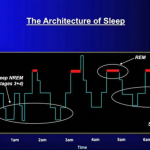
Secrets of Sleeping Brain - Architecture of Sleep - Prof. M Walker, 2009

Fig. 1. Sleep Hypnogram (After M. Walker, 2009) – Click on the figure for enlarged view.

First of all, I would like to correct the misconception that some of us have that the moment we hit the pillow and get lost in sleep, we just flow through one continuous phase of dreaming, then deep sleep and, lo  behold, we get up refreshed in the morning. So, to this extent, the sequence of Awake state (A), Dream state (U), and  Deep sleep (M) corresponding to AUM as presented by Mandukya  Upanishad is awfully way out. ***  The Upanishad says that these three states arise in an everlasting turIya which is compared to the ‘silence’ at the end of AUM. ***  Several experimental studies carried out over a period of more than half a century demonstrate that the architecture of our sleep pattern is vastly different as experienced by us every night. A typical hypnogram (the nightly sleep cycle) we go through each night is shown in Fig. 1. (Please click on the figure for an enlarged view).
Continue reading

Reincarnation – Q.335

Q: As you know, all spiritual traditions in Tibet, many in India and even the early Christians took reincarnation for granted.

 In Advaita however the idea is blatantly refused. Balsekar says, since there is no ego and the idea of an individual person is an illusion, what or who is there to be reincarnated?

Does this mean that the other traditions are wrong or is it a question of understanding, meaning that the people who argue differently do so from a different level of understanding / consciousness? Continue reading

Traditional Teaching and Deep Sleep – I

Part – I        Part – II          Part – III 

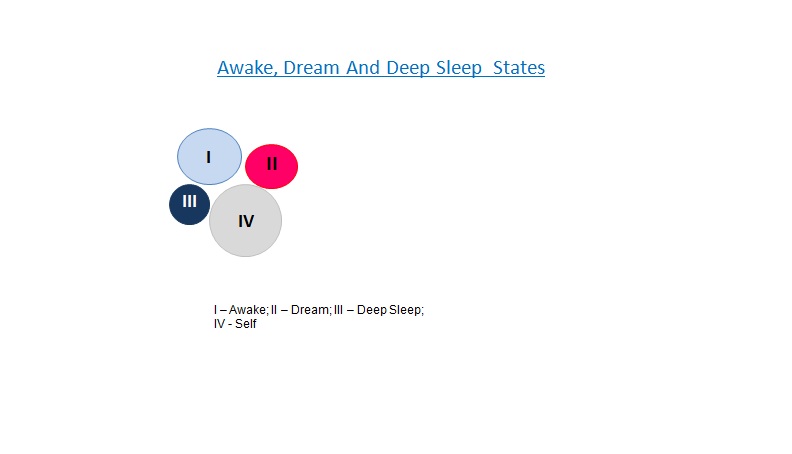
In my Talk on “Inquiry in Science and Vedanta “, the slides numbered 50 and 51 are about  the three states of  consciousness — Awake, Dream and Deep Sleep. (The full PowerPoint Presentation can be viewed at : http://beyond-advaita.blogspot.in/ ). The three worlds are represented by the three distinct circles I, II and III and a ‘Me’ is shown by the circle IV in the Slide 50 (Fig. 1 below). In our normal understanding, we think that “I am a separate ‘self’ (individual) and I pass through three distinct worlds viz. the Wakeful world, the Dream world and the Deep Sleep world.” We also take that the worlds to be external to ‘me.’

Fig 1: The Normal Worldview – an individual “I” (IV) passes through three distinct worlds (I, II, III) that are external to ‘me’ during a day of 24 hrs.

Continue reading

Incomplete Enlightenment – Q.333

Q: As I understand, the sense of “I” (distinguished from the ultimate I/Self)  is the source of “ignorance”. “Ignorance” leads to “the fear”, which inspires us to attempt to find “enlightenment”. The attempt to find “enlightenment” is the delusion that there is something to gain. The teachings tell us that “enlightenment” is the nature of existence. What needs to happen is the destruction/removal of ignorance, rather than the acquisition of anything. I already feel as if I have approached the “screen” upon which phenomenon occurs. By practicing “neti neti”, I attempt to see what always is, which is a temporary attempt to disregard things that can be seen. Once this happens, there is the inference of blankness/darkness/all-inclusiveness/voidness. And once this practice of “neti neti” is over, I begin to see things come of themselves, from little sparks … flakes of concepts … to their blooming as a climax of a concept. The climax wanes and the concept disappears of itself just as it arose.

A short time after this attempt at enquiry, the ease I had with reality fades. The sense that reality is not okay begins to gradually return. It feels as if I missed something from this experience. At other times, I feel as if perhaps this effort is part of the problem. Maybe the enquiry is meant to be a last ditch attempt to notice the fallacy of trying to do something, or even the attempt to try to do nothing.

 Is this the realization? That effort is resistance? That surrender to this fact is the ultimate motion?

 How does it happen that one can know “in the mind” that one is free, and yet continue to fall back into the conundrum of no longer feeling this freedom? Moments of complete freedom … knowing that it’s not my business to “do” life, not even to attempt to not “do” life … and yet slowly fall back into the habit? Continue reading

Creativity – Q.332

Q: What happens to creativity (writing painting music… ) when you awake from the dream of dualism ?  

A (Peter): What happens to waves when they are known to be nothing but water? Do all waves lose their distinctiveness? Do they suddenly freeze mid-motion?

 It is an error to believe that either there is a blank, distinctionless ‘non-duality’ or a rich, exciting, variegated universe. There is only consciousness and every exciting, beautiful thing – gross and subtle – is an expression of it. The painting, the act of painting, the impulse to paint, the paint, the brush, the painter are all an expression of the secondless, non-dual consciousness. Continue reading

Beyond Stillness – Q. 331

Q : I am a “solo practitioner” of the advice of Ramana Maharshi, as I understand what I absorb of it. My enquiries move between an apophatic and cataphatic flavor.

 When I do this, I am moved to an absolute stillness. Upon ‘coming back’, there is a sensation of still not passing the barrier of stillness. I am not sure how to continue. Should I continue to practice just like this? Until I have destroyed differentiation? Should this be a lesson on what the real really is?

[Note (Dennis): Here are the meanings of those terms from my Oxford dictionary –

apophatic /ap’fatk/ – adjective Theology (of knowledge of God) obtained through negating concepts that might be applied to him. The opposite of cataphatic.

cataphatic /kat’fatk/ – adjective Theology (of knowledge of God) obtained through defining God with positive statements. The opposite of apophatic.] Continue reading

Vision Of Truth (sad darshanam – 5)


Arbhyate jIva jagat parAtma

tattvAbhidhAnena matam samastam

idam trayam yAvadahamatiH syAt

sarvottamASham mati shUnya niShThA—4


Arbhyate = begins;  jIva jagat parAtma = divisions of individual, world and Ishvara; 

tattvAbhidhAnena = principles of the three tattvAs;  matam samastam = all philosophies; 

idam = this; trayam = three;  yAvat = as long as; ahamatiH = ‘I’ notion; syAt = is there;

sarvottamA = the greatest of all; aham mati shUnya = devoid of ego; niShThA = 

abidance; 


All philosophies begin based on the principles of the three divisions of individual, world and Ishvara. The abidance in self, devoid of the ego is the greatest abidance of all.


All religions are based on the three divisions of individual, total and world. These religions culminate in some philosophy which again is based on this triad only. Theology sticks to these divisions and does not attempt to go beyond. Continue reading

Book Review: FREE WILL

Free Will by Sam Harris, Free Press, 2012, pp: 83, ISBN 978-1-4516-8340-0

free will book cover sam harris

I always wondered at the American marketing wizardry of bite-size chocolates and peanut butter cups that lure the consumers. If a book on a highly intriguing, tantalizing and no less controversial a subject like Free Will is presented in bite-size, even a die-hard Advaitin can hardly hold his temptation to take a bite! And I did.

Perhaps one should call it a long essay discussed under eight or so subheadings rather than a book. You hardly open the cover and right away, the text begins with “The question of free will touches nearly everything we care about” — no Intros, no Forewords, no time wasted. And then as suddenly, the author explodes the myth of ‘our viewing one another as autonomous persons, capable of free choice.’ He writes:

“If the scientific community were to declare free will an illusion, it would precipitate a culture war far more belligerent than one that has been waged on the subject of evolution. Without free will, sinners and criminals would be nothing more than poorly calibrated clock-work……  And those of us who work hard and follow the rules would not “deserve” our success in any deep sense. It is not an accident that most people find these conclusions abhorrent. The stakes are high.”

The stakes may be high; but Advaitins will surely cheer the author, Sam Harris, a Ph. D. in Neuroscience on those scientific declarations. Continue reading

Non-dual Reality – Q. 328

Q: Can one ever KNOW that reality is non-dual?

A (Ramesam):

(i)   YES, The moment you can grasp tight your reflection in the mirror!!! 
(ii)  No, you cannot know it like you know the salary you get.

(iii) Yes, you cannot ever NOT know it; what all IS, is your perception alone.
(iv)  No, if you place yourself aloof trying to know it as a distant object.

(v)  Yes, you know It in your deep sleep.
(vi)  No, if you want to measure and compare to duality. Continue reading

Vegetarianism – Q. 327

Q: I need clarity on some questions.

 01. The understanding is everything is life/consciousness/totality, it is the totality that functions through animals including human beings ( so-called separate entity/Body Mind Organism) and life/god/consciousness’ true nature though indescribable in words has been described as Sata Chit Ananda in other words peace love etc. So my question is if that is true why animals attack and kill, when they too have Life? Though humans too do that but, Master has good explanation for that under Advaita teaching as to why humans possibly do wrong or kill. One answer some what suffices when it comes to humans in particular as to why they kill or do wrong, i.e. when this impersonal consciousness identifies with the body and mind suit, there is every chance that actions that will happen will be imbued by the understanding that I am a body and so are others and actions with ignorance can take place, but the question is what about in the case of animals, why they do kill/attack if they have Life or rather they are Life? Continue reading