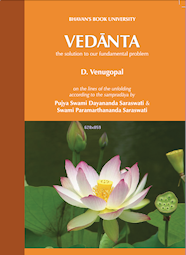
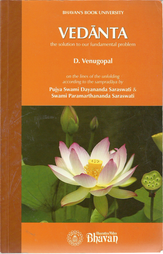
VEDĀNTA the solution to our fundamental problem by D. Venugopal
Part 37 begins the analysis of Cause and Effect and introduces the concept of mithyA.
There is a complete Contents List, to which links are added as each new part appears.

VEDĀNTA the solution to our fundamental problem by D. Venugopal
Part 37 begins the analysis of Cause and Effect and introduces the concept of mithyA.
There is a complete Contents List, to which links are added as each new part appears.
Q: Swami Paramarthananda makes the following comments in his talks on upadeSha sAhasrI:
Atma, though a knower of everything, is not a known object, because, if Atma were to be a known object it will need another Atma to know, leading to what is known as infinite regress (anavasta dosham). Atma cannot be known by itself, because, to be known by itself, it has to become both the subject and the object, which is not possible as one and the same entity cannot function as subject and object simultaneously.
We cannot also say that one part of Atma can be known by another part, as Atma is by definition partless. Thus, Atma is ever the knower but not known by others or by itself.
No Proof Needed
As Atma is self-evident, its existence needs no proof. That I am conscious is evident to me. The very search for proof is possible because of my being conscious. Thus, Atma is revealed as self-evident Witness Consciousness which illumines everything and which cannot be objectified by anything. This Atma is my real nature. All the known attributes belong to the known objects and cannot belong to the knower, Atma (consciousness). Continue reading
Q: The question about Ishvara, Atman, Brahman gets confusing once a person starts reading and gaining knowledge from different branches of religions or schools of philosophy. So to put my question as simply as possible: If we are all Brahman then how does Karma come into play for us as individuals ? (As technically it’s Brahman acting against Brahman.)
One other thing:
Let’s say there are two people ( You and Me ) who realises the truth and doesn’t need to take rebirth again, so once their body dies, their Atman merges back with Brahman. So once that happens, do both these people become one ? At the highest level, Yes ! Because they were always One ! But would a part of them both remain ‘Them’ ? As in a person who sent a mail and a person who replied to it ? If so, then is that ‘Part’ what we’d call a soul ?
A (Dennis): In reality there is only brahman, non-dual, formless, eternal etc.
The world (including the ‘person’) is mithyA, neither real nor unreal, depending for its existence on brahman. The ‘person’ is a mind-body, ‘animated’ by Consciousness via a ‘reflection’ of brahman in the mind. This concept, called chidAbhAsa, is fundamental to understanding the seeming problems you raise. See my essays on this subject: There is an article called “The ‘Real I’ verses the ‘Presumed I’ – An Examination of chidAbhAsa” – https://www.advaita-vision.org/chidabhasa/ and a follow-up blog called ‘Continuing Reflections on Reflection’ at https://www.advaita-vision.org/continuing-reflections-on-reflections/. Continue reading

Back in April I wrote an article which looked into the concept of chidAbhAsa – https://www.advaita-vision.org/chidabhasa/. This is the idea that the ‘notion of I’ is a reflection, in the mind, of the non-dual consciousness. The theory is called pratibimba vAda in advaita. It says that there is only one ‘real’, pAramArthika or witnessing Consciousness, although there are many jIva-s; one ‘original’ (bimba) and many ‘reflections’ (pratibimba-s).
But of course, reality is non-dual, so it makes no sense to talk of a ‘Consciousness’ and a ‘reflected Consciousness’! So how do we explain this? In order for there to be a reflection, there have to be two things: an original thing, and some medium in which a reflection can take place. This is obvious in the case of the mirror. We cannot see our face in order to be able to shave or apply make up by looking into empty space. We cannot even do it by looking at a blank wall. There has to be a mirror or some reflecting medium which can serve as a mirror. Here, we seem to be saying that there is Consciousness and a reflecting medium – the mind. But of course if we have these two things, then we’re talking about dvaita not advaita.
Shankara’s Advaita introduces the concept of mAyA to provide a sort-of explanation for the world-appearance but the dvaitin may argue that, pedantically, brahman and mAyA are still two things. Only if we can explain everything in terms of paramArtha alone, he might say, can we establish non-duality. Of course, we can be pedantic too – you cannot explain anything in paramArtha, only in vyavahAra! But we acknowledge that mAyA is mithyA. In reality, there are no jIva-s, no world, no reflections. So, the bottom line is that reality is non-dual, so that we do not really have to justify the theory at all! Continue reading

Understanding Reality
in the Vision of Advaita Vedānta
by Wolfgang P., wpl@gmx.net
Read Part 2 of this article
What is ‘everything that is experienced’? It is the empirical universe, the world, jagat, which consists of everything we experience. Every object or content of consciousness is jagat, and this jagat is mithyā, depending upon sat-cit for its existence. Not only the gross objects, but also the subtle ones, like emotions, thoughts, concepts and so forth. There is literally no limitation to the possible contents of consciousness. Even when you say, “I found something that cannot be an object of consciousness” you have proven yourself wrong at the very instance, since this ‘something’ has to be already a content of consciousness to make the claim in the first place.
Is consciousness limited space-wise or time-wise? If yes, consciousness would be an object within space and time, having a certain location, a certain spatial and temporal expansion. But this is not the case. Consciousness is not an object within space and time. It is the other way round: Space and time are experienced in consciousness, so they are also mithyā. Furthermore, sat-cit is not limited spatially. Consequently, there cannot be two of them, otherwise they would have a spatial border. Therefore, sat-cit can only be one. If we apply this reasoning to time, the same applies. As time is mithyā to sat-cit, sat-cit cannot be dependent upon time. Hence, sat-cit is beyond time, which means it is uncreated, ajāti, and eternal. Continue reading
Q: On the subject of karma please could you explain who or what decides on the destination of the “stamp/soul/” to a higher or lower life form. It would seem to be a judgmental decision based on our behaviour so presumably cannot be “Self” which is unaffected and affects nothing?
A (Dennis): You have to distinguish between paramArtha and vyavahAra. The absolute reality is that there is only brahman – non-dual Consciousness. There is no world separate from Consciousness, no people separate from Consciousness. The world and people are mithyA. So, in reality karma has to be mithyA also; there is no birth, no death, no reincarnation, no one who acts and no one to be reborn as a cockroach.
Explanations at the level of vyavahAra are interim explanations for the benefit of someone who does not yet appreciate the above. At this level, there seems to be cause and effect and all the apparent scientific laws that operate in the world. Ishvara is the name given to the ‘entity’ of ‘brahman + mAyA’ who lays down these laws. But the laws are not operated by Him on an individual basis; they are simply the ‘rules’ that are necessarily followed by everything in creation (such as gravity, Newton’s Laws etc). There is no ‘judgement’ involved at all.

(Read Part 7 of the series.)
Empiricism and Idealism Locke and Berkeley)
Empiricism
Born some eighteen years before the death of Descartes, the Englishman John Locke claimed that reason was not the principal means for finding out about the world, as the earlier philosopher had contended. Instead, he advocated an empirical approach to knowledge, i.e. using one’s senses actually to see what is the case. This is the only means for obtaining raw data and we use reason subsequently to make sense of it. Only then can it become knowledge. He believed his own purpose in life was to enquire into human knowledge to discover its limits and the extent to which we could be certain of it.
Unlike modern, evolutionary psychologists, he believed that we are effectively born with no innate knowledge, a metaphorical ‘blank slate’. All of our knowledge and understanding is therefore built upon information derived from our senses. Everything we know or think about ultimately comes from experience. The limits of what we can know about reality are fixed by the abilities of the senses and the associated mental equipment. Continue reading

The discussion that follows stems from a comment I made on a recent article in the July NOW Newsletter. This is produced by a group in Australia led by Alan Mann and is a resource for the works of Thomas Traherne, as well as Douglas Harding, John Wren-Lewis and George Schloss.
I publish our email exchanges verbatim, as they occurred, below. Please feel free to add any useful comments!
Hi Alan,
Regarding your preferred definition of ‘real’ (“The definition of real which I prefer is: actually existing as a thing or occurring in fact; not imagined or supposed.”):
Does a chair exist? As a chair? What if I remove the legs and back; is it still a chair? Was it a chair a year ago, 10, 100, 1000 years ago? What about similar periods in the future? I suggest that it is not the chair that exists at all, it is the wood out of which it is made. (And the same argument applies to the wood over longer timescales.) A ‘chair’ is not real; it is only name and form of wood. Etc. ‘Things’ are not real; no ‘thing’ exists in its own right; it is dependent upon something more fundamental for its existence. And this goes on, all the way back to Consciousness.
Have you read the story I wrote about this? – the ‘first definition’ at http://www.advaita.org.uk/discourses/definitions/advaita.htm. You can publish this in your next edition if you like.
Best wishes,
Dennis Continue reading

Understanding Reality
in the Vision of Advaita Vedānta
by Wolfgang P., wpl@gmx.net
Read Part 1 of this article
Let’s use this method of inquiry to investigate another ubiquitous entity: What is the reality of money? Ask someone on the street if money is real, you would hardly find anyone doubting it. But what actually ‘is’ money? We assume it is real, but what is the substratum of its reality? Is it independently real or does it depend on something for its existence? Is money just the amount of coins in your wallet? Certainly not, since money also appears as bills, cheques, and as digital data. Today the majority of the world’s money is stored as binary code on hard drives. Is the reality of money the binary code on the hard drive, which is storing the balance of the bank account?
Let’s imagine, an alien species visits our planet for the first time. In their foreign culture the concept of money is unknown. Would it be obvious for them to learn what money is, by simply investigating the data of the hard drive? All they could do is extract the data, but they would lack the contextual information about what to do with it. Therefore, money, which seems very ‘real’ to us practically, has no physical substratum. It is only by convention that coins, bills, or digital data act as a symbolic carrier for money. The reality of 10 USD does not originate from a 10-dollar bill. If the money were ‘in’ the bill, it would be impossible to replace an old bill for a new one. Physical carriers, like coins or bills, act as a medium for money, but they ‘are’ not money. Continue reading

Understanding Reality
in the Vision of Advaita Vedānta
by Wolfgang P., wpl@gmx.net
We, as human beings, are interested in reality. Unlike animals, we are able to ask questions about the nature of our experience. We understand that experiences are numerous and fleeting, so the question arises: What is the reality behind those experiences? From this question subsequent ones emerge: What does it mean to say something is ‘real’ or ‘unreal’? What is the nature of reality? Vedānta is a body of knowledge to analyze the nature of reality and its relationship to the individual (jīva). It applies a teaching methodology that has been handed down from teacher to student since time immemorial. The aim of Vedānta is to make one understand its fundamental tenet:1
ब्रह्म सत्यं जगत् मिथ्या जीवो ब्रह्मैव नापरः
brahma satyaṃ jagat mithyā jīvo brahmaiva nāparaḥ
Brahman is the only truth (satyam), the world, jagat, is unreal (mithyā), and there is ultimately no difference between brahman and the individual self (jīva).
In this article I will explain the three categories Vedānta provides to understand reality: sat or satyam, asat, and mithyā.2 When we talk about reality, we need to distinguish that-which-is-real from that-which-is-not-real. This discriminative inquiry is called tattva-viveka. In Sanskrit, that-which-is-real is called satyam, whereas that-which-is-not-real is called asat. Continue reading