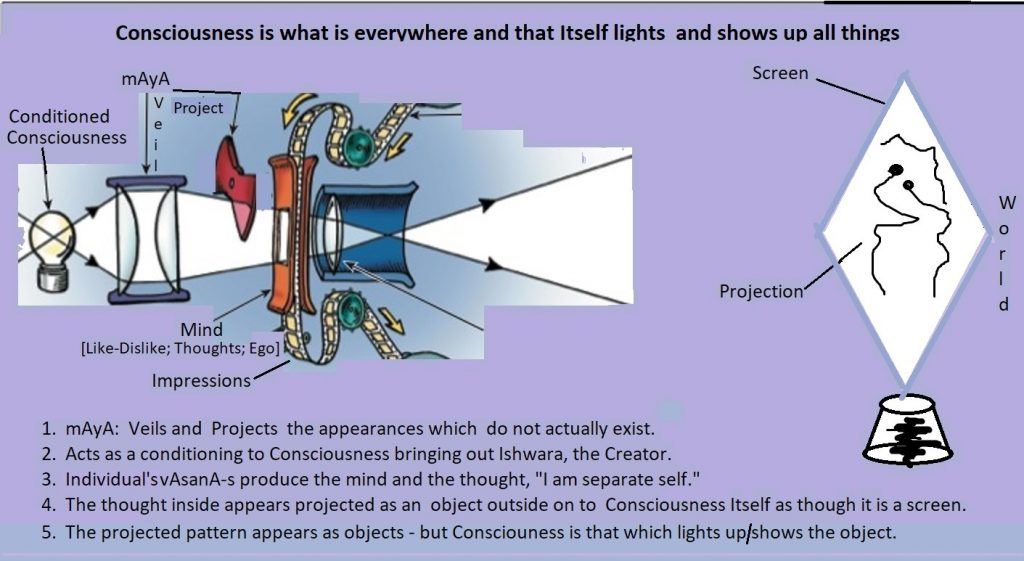
Manifestation/Appearance – A view

In Advaita Vedanta, it is said that the world is a manifestation/appearance of Brahman like ornament (world) and gold (Brahman) in gold-ornament metaphor. A hearer is puzzled as to how can the material world be envisaged as a manifestation/appearance of Brahman which is of the nature of pure existence (Existence) and is non-material. Existence is not perceived, world is perceived, whereas both gold and ornament are perceived. In this sense, the hearer argues that there is a disconnect of the gold-ornament from Brahman-world.
The counter argument from a co-hearer is that a metaphor is never similar to the thing illustrated for otherwise it ceases to be a metaphor. The principle is that in a metaphor, similarity is the focus and dis-similarity is ignored. In the instant case, dis-similarity due to material and non-material is ignored. What is the similarity then? Here comes the concept of mithya, i.e., neither nor unreal. Brahman is of the nature of Existence. It lends existence to the world which has no independent existence as it continuously changes. Brahman is real and world is mithya (ब्रह्म सत्यं जगन्मिथ्या). In the gold-ornament metaphor, ornament has no existence separate from that of the gold. Gold is real and ornament is mithya. Thus, there is a similarity (of mithyatatva)  between the illustration and the illustrated.
Agreement: In the gold-ornament metaphor to explain that the world is a manifestation/appearance of Brahman, the focus is on mithyatatva.

The Barren World

In my last post, I promised that I would provide another (clinching?) argument as to why the world does not disappear on enlightenment. Here it is. I use this in the book that I have just completed, which provides lots of examples of how many modern teachers misrepresent the various topics in Advaita, leading the seeker on a merry path that is unlikely to lead to enlightenment. (I have only just sent this to the publisher so it will not appear until the end of next year at the earliest. It will be called: ‘Finding the Self: A Guide Through the Minefield of Modern Advaita’.

Continue reading

The Limitations of Metaphor

Advaita teaching frequently makes use of metaphor in its explanations of the various topics. These are indisputably invaluable, although there is also the danger of taking them beyond the realm of their applicability and either drawing erroneous conclusions or simply failing to see the point that is being made. This also highlights the necessity of using the metaphor that is most appropriate for conveying the message. Take the example of sarvam khalvidam brahma – all this (world) is really Brahman.

We might start with the ubiquitous rope-snake metaphor. We think we see a snake but the light is poor. (We think we see a world of separate objects, but we haven’t yet gained the Self-knowledge of Advaita – our perception is covered by ignorance.) When we bring torchlight to shine into the darkness, we see that it is really a rope. (Having been taught Advaita, we realize that the world is really name and form of Brahman.)

Continue reading

The Darkness of Ignorance (Part 6)

*** Read Part 5 ***

‘Existence’ of Ignorance

So, does ignorance actually exist; a concrete ‘object’ in space and time? There is the occasional reference in the scriptures (e.g. in the Ṛg Veda) but these speak of related gods, supernatural events and so on. Where such a concept is a part of the pseudo-mystical precursor of Advaita teaching proper, I personally cannot accept it as a valid reference. E.g. I suggest that ‘before light, there was darkness’ does not count as a proof that darkness is an ontologically existent entity!

There are also references in the Bṛhadāraṇyaka Upaniṣad and Sureśvara’s Vārttika on Śaṅkara’s bhāṣya but, again, this being the oldest of the Upaniṣads, there is a lot of ‘mystical’ material much pre-dating Śaṅkara’s systematization of the philosophy.

One of the quotations sometimes given to support the contention that scriptures cite ignorance as a real entity is Sureśvara’s Vārttika on Puruṣavidha Brāhmaṇa (1368):

ajñānaṃ saṃśayajānaṃ miśyājānamiti trikam
ajñānaṃ kāraṇaṃ tatra kāryatvaṃ pariśiṣṭayoḥ

This is translated as:

Ignorance, doubt-born knowledge, and mixed knowledge are the triad. Ignorance (ajñāna) is the cause there, while the other two (doubt-born knowledge and mixed knowledge) are effects.

Continue reading

The Darkness of Ignorance (Part 5)

*** Read Part 4 ***

Tamas

‘Darkness’ is also used in the sense of the ‘primordial condition’ of the universe prior to creation. In this sense, it is not metaphorical but part of the ancient Hindu cosmology. It appears, for example, in Ṛg Veda 10.129: “In the beginning, there was darkness (tamas) hidden in darkness. All this was one undifferentiated water.” And the stage of pralaya, when the universe returns to unmanifest form, is sometimes described as darkness. A number of Puranic references could be quoted, e.g. the Vishnu Purana (Book 1 Chapter 1): “At the end of the previous kalpa, there was only one vast ocean, enveloped in darkness (tamas). The universe was in total dissolution, and nothing but the incomprehensible God, Vishnu, existed.” The darkness also symbolized the formlessness prior to creation.

This usage as an existent entity is not really the same as the metaphorical usage in which it symbolizes ignorance or ‘absence of knowledge’.

Darkness as Metaphor

In the context of discussions on ignorance, then, darkness is not intended to be considered as a real entity but as a metaphor for ignorance. We can see how this is both useful and potentially misleading. If we think of the common ‘concealing’ usage of the word – e.g. we could not see the stalactite in the cave because it was ‘covered by’ darkness – then we are in trouble. If we simply rephrase this to say that, because there was no light in the cave, we could not see the stalactite, there is no problem.

Continue reading

Q. 532 Brahman, name and form

Q: To speak of levels or to even say ‘name and form’, isn’t technically correct, is it? There’s only Brahman – period. I ask or say this because it does make a big difference between understanding and ‘living it’.

A: You are right. Pedantically there is only Brahman and even that is saying too much. But all transactions take place in vyavahAra (often referred to as ‘transactional reality’) and that obviously includes the teaching itself. That is why we have words like ‘mithyA’, so we can acknowledge the appearance of duality. We undeniably perceive form and refer to it by name, but acknowledge that it is mithyA – owing its substantial existence to Brahman.

Q: Having this final understanding, does the Mithya go on as:
1. As Ashtavakra Gita says… “a dry leaf being blown in the wind”? 
Or
2. An actor knowing he’s an actor and playing roles like a movie?

A: The reasoning behind metaphors is to nudge the mind into appreciating the teaching of something that is counter-intuitive. Once you have ‘got it’, the metaphor should be dropped. The nature of the remainder of the life of a j~nAnI will be dictated by their individual prArabdha karma so will be different for everyone.

The reification of ignorance

The reification of ignorance or the One-percent Brigade

There has recently been a brief spate of posts relevant to this topic on the Advaitin List. I rarely post there these days for fear of getting involved in long arguments with members committed to opposing views. But, after someone claimed that 99% of Advaitins accepted that ‘ignorance’ was a really existent entity, I posted to assert my membership of the ‘1% Brigade’, explaining that “I mainly wanted to reassure those readers who were dismayed to think that they were in the 1% and apparently did not understand Advaita!”

What I said was:
“(In volume 2 of ‘Confusions’), one of the aspects that I specifically address is the notion of avidyā as a really existent entity and I am afraid that I have to conclude, using reason and common sense, as well as the quotations, that what is meant by ‘ignorance’ is simply ‘lack of knowledge’. Essentially, it is a language problem. So, yes, there is certainly ignorance in the deep-sleep state, simply because the mind is resolved and incapable of having knowledge about anything. But there is no mūlāvidyā, I’m afraid. And I hope that many will be convinced if they read all of the arguments.”

Continue reading

Q.488 Reading Minds

[Note: This is a long Q&A. Any help that other bloggers and readers can give to resolve the questioner’s concerns will be welcomed!]

Q: If waking life is a kind of dream or modulation of awareness then why is it so continuous? Many Advaitins see waking life as some form of dream, correct me if I’m wrong.

Dreams when asleep are always very new, different and unpredictable. And then they disappear and you wake up and forget the dream. And most likely you will not continue where it ended next sleep. On the other hand, waking life reappears after sleep and it is the ‘same’ as yesterday and it only seems to disappear if you die.

A: There is a lot more to it than that. And it cannot all be explained in a couple of sentences. Pretty much all of my book ‘A-U-M: Awakening to Reality’ was about this. (It is a commentary on Mandukya Upanishad and the explanation by Gaudapada.)

There are 3 states of consciousness – waking, dream and deep sleep and none of them are ‘really real’. Waking seems to be real for the waker. The dream is equally real for the dreamer (who thinks he is a waker)! The true reality is the Consciousness that is the basis of all 3 states. Waking life is said to be like a dream so that you can use this as a metaphor for gaining enlightenment. Continue reading

Q.476 – Metaphors

Q: Which metaphor in Advaita is the closest to truth? For example:

1.      If I take the “Snake in rope” metaphor, I must consider that “there-is-something” called rope, which is mistaken for something else (snake). So, in this metaphor, there is a TRUE rope and UNTRUE snake.

2.      If I consider the “Water in Mirage” metaphor, there is the UNTRUE water, but there is no substrate on which this is happening (there is no rope equivalent here).

3.      If I consider the “Dream” metaphor, there is the UNTRUE dream cosmos and dream characters and there is the TRUE dreamer in whose mind all this is happening. So the substrate is the dreamer’s mind – though it is “no-thing” in itself.

The doubt is…
Metaphor 1 gives an impression that there “is-something” out there, but we mistake it for something else and give it name & forms etc.

Metaphor 2 gives an impression that there is “nothing out there” and what we see is only inside our mind (the mirage has no substrate out there, but just an error in our mind).

Metaphor 3 is somewhat in the middle of metaphors 1 & 2 – Like metaphor 1, it has a TRUE substrate (the dreamer’s mind) but that substrate itself is just mind stuff (like metaphor 3) which can appear and disappear instantly, following no rules of any sort (rope will follow some rule, but a dream elephant may fly).

So is there something “out there” (some ineffable substrate – say energy) which is misunderstood as something else (say matter, forms) OR there is “nothing-out-there” and whatever we see is only our minds-stuff in motion?

Many thanks to the teachers for having this forum where seekers could ask their questions and helping others see the great truth! Continue reading