Q: I am reading your book ” Confusions in Advaita Vedanta”.
I am from India, born in the Smarta Brahmin tradition of The revered Adi Shankara.
The purport of Adi Shankara as repeatedly explained by you is that no pramana or meditation except shabda pramana, teaching of scripture expounded by qualified teacher can give jnana. And this understanding happens in the process of listening once. Repetitions don’t help.
This caused both enthusiasm and later negativity in me. I have heard scriptures being expounded by Swami Dayananda, Swami Paramarthananda, Swami Brahmananda, Swami Parthasarathy, Sri Gangolli (translator of Swami Satchidananendra) etc. But no understanding or Jnana has resulted.
Am I doomed? Or Does it mean I was not qualified enough? More yoga sadhana required for purifying my mind? Of course there can be no doubt that the teachers were qualified. So fault is mine.
Author Archives: Dennis Waite
Q.527 Experiencing Brahman
Q: What does this mean: You can’t experience brahman, but everything you experience is brahman?
A (ChatGPT): This statement is an expression of the non-dual nature of reality as understood in Hindu philosophy, particularly in the Advaita Vedanta tradition.
According to this view, Brahman is the ultimate reality that underlies all existence. It is an unchanging, infinite and eternal principle that is beyond all concepts and categories. However, because of the limitations of our minds and senses, we cannot directly experience Brahman as an object or as a concept.
Despite this, everything we experience is seen as an expression or manifestation of Brahman. In other words, all the objects and phenomena we encounter in the world around us are ultimately a reflection of the underlying reality of Brahman. In this sense, everything we experience can be seen as a kind of pointer or signpost that can lead us towards a deeper understanding of the nature of reality.
Thus, the statement “You can’t experience Brahman, but everything you experience is Brahman” is a way of expressing the non-dual nature of reality, in which the ultimate reality is both beyond all experience and yet present in everything we experience. It suggests that while we may not be able to directly experience Brahman as an object, we can still recognize its presence in the world around us and use that recognition as a means of coming to a deeper understanding of the nature of reality.
mANDUkya upaniShad Part 5
Mantra 4
*** Read Part 4 ***
स्वप्नस्थानोऽन्तःप्रज्ञः सप्ताङ्ग एकोन्विंश्तिमुखः प्र्विविक्तभुक् तैजसो द्वितीयः पादः॥ ४॥
svapnasthAno.antaHpraj~naH saptA~Nga ekonaviMshatimukhaH praviviktabhuk taijaso dvitIyaH pAdaH || 4 ||
dvitIyaH pAdaH – The second aspect (of the Self)
taijasa – is called taijasa.
svapna sthAna – (Its field of action is) the dream state.
antaHpraj~naH – (Consciousness is) turned inwards (as opposed to the waking state in the previous mantra, where it was turned outwards).
sapta a~Nga – (As with the waking state) (it has) seven divisions.
viMshati mukhaH – (and) nineteen interfaces.
praviviktabhuk taijaso – taijasa is the enjoyer (bhug = bhuk = bhoktA; experiencer, enjoyer) of the private, internal world (pravivikta).
The second aspect of the Self is taijasa. This is the dream state in which one’s awareness is turned inwards. taijasa has seven parts and experiences the dream world via 19 interfaces.
Continue readingQ.526 MithyA
Q: In your comment on the article by Arun Kumar, I was confused but intrigued that you define Mithya as something that simply explains the fundamental nature of the Brahman in life and its objects. I have not so far found any dictionary that defines mithya as anything other than false or illusory nor discovered any major scholar-philosopher who thought that Shankara viewed this world as a reality – as real as the ornament in your metaphor. You say that Shankara himself by discriminating between the waking and dream states suggests that novel meaning of Mithya. Is this your own interpretation or does Shankara himself link the ability to differentiate between those states to explain mithya?
You raise the example of how jumping into the middle of traffic would help one realize why this world is NOT an illusion… but it is not convincing enough. Potentially, both a person jumping in front of a truck and his consequent “death” could be perceived as illusory events too. The real question I have is whether Shankara himself viewed this world as illusion and used Mithya to convey that or not. And, if it was an illusion for him, what did he think the meaning of life was? If on the other hand life was Not an illusion to him, as you seem to suggest, what was its purpose in that case?
Continue readingmANDUkya upaniShad Part 4
Mantra 3
*** Read Part 3 ***
जाग्रितस्थानो भिष्प्रज्ञः सप्ताङ्ग एकोन्विंश्तिमुखः स्थूलभुग्वैश्वानरः प्रथमः पादः॥ ३॥
jAgaritasthAno bahiShpraj~naH saptA~Nga ekonaviMshatimukhaH sthUlabhugvaishvAnaraH prathamaH pAdaH || 3 ||
prathamaH pAdaH – The first aspect (of the Self)
vaishvAnara – is vaishvAnara (or vishva)
jAgaritasthAna – (This is) the waking state
praj~na – (and it is one in which one’s) knowing awareness
bahis – (is) turned outwards
sapta a~Nga (a~Nga literally means ‘limb’) – (This aspect has) seven divisions ekonaviMshatimukhaH – and nineteen interfaces (with the outside world) (viMshati is ‘twenty’ and ekona is ‘one less than’; mukha literally means ‘mouth’ or ‘opening’)
sthUlabhugvaishvAnaraH – vaishvAnara (is) the enjoyer (bhug = bhuj = bhoktA; experiencer, enjoyer) of the gross world.
The first aspect of the Self is vaishvAnara. This is the waking state in which one’s awareness is turned outwards to the external world. vaishvAnara has seven parts and experiences the universe via 19 interfaces.
Continue readingTime according to Advaita
Martin,
Your post made me realize that I have rarely, if ever, encountered any definition/explanation of the concept of time in Advaita. It set me off on a search of my library to try to find something. Apart from those books which index every word they contain (e.g. Krishnaswamy Iyer’s ‘Vedanta or the Science of Reality’ has 107 page-references to ‘time’), I could not find anything in any of my physical books. A search of my electronic database came up with very few references and the only scriptural one I could find is from Vivekachudamani 497:
sthulādibhāvā mayi kalpitā bhramā-dārōpitānusphuraṇena lōkaiḥ |
kāle yathā kalpakavatsarāya-ṇartvā dayō niṣkalanirvikalpe ||497||
John Grimes translates:
Sthūlādi = gross and so on; kalpita bhramāt = erroneously imagined; āropitānu-sphuraṇena = manifestation superimposed; kale = time; kalpaka = eons; vatsarāyaṇa = years and half-years; ṛtvādi = seasons and so on.
Continue readingThe preservation of the sacredness of Kashi
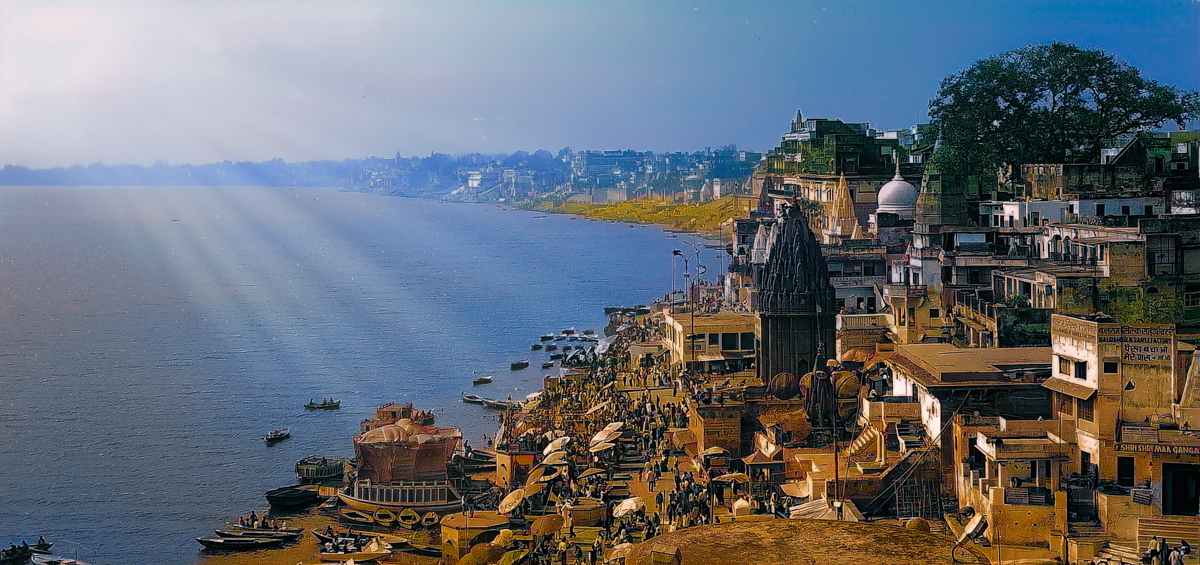
A letter from a guest writer pleading against planned desecration of the city of Varanasi.
Dear friends,
I write this as a lover of Kashi-Varanasi-Banaras, the city I have been living in since 1989.
From the time I first came to Kashi in 1982 and then resided here for more than 33 years, many changes have happened in the city. The most important is the great increase in population and the arrival of motorized traffic, which has collapsed the city to a great extent. For many years, no developments or renovations were done.
Continue readingmANDUkya upaniShad Part 3
Mantra 2
*** Read Part 2 ***
सर्वं ह्येतद् ब्रह्मायमात्मा ब्रह्म सोऽयमात्मा चतुष्पात् || 2 ||
sarvaM hyetad brahmAyamAtmA brahma so.ayamAtmA chatuShpAt
sarvaM etad – Everything here
hi – (is)certainly
brahma – brahman.
ayam AtmA – This Atman
brahma – (is) brahman.
saH ayam AtmA – This very Atman
chatuShpad (= chatur + pAda) – (has) four aspects.
Absolutely everything is brahman. This Atman is brahman and has four aspects.
In the first mantra, OM was said to be everything. (How this is so will be analyzed in mantras 8 – 12.) The Upanishad now asks what is the nature of this Self, Atman; mantras 2 – 7 make this enquiry.
Continue readingbAdha versus nAsha
The following was posted to the Advaitin List by Satyan Chidambaran, who has agreed for me to record it here.
There is a distinction between bAdha (sublation) and nAsha (destruction) that the tradition makes.
To know that a Pot is not real, and only clay alone is real, one shouldn’t need to destroy (engage in nAsha of) the Pot appearance. One just needs to know clearly that the Pot is just a name and form and Clay alone really exists. Therefore, even when seeing a Pot, a “Clay j~nAnI” knows clearly that the Pot is mithyA nAma rUpa and Clay alone is satyam. This is bAdha of the Pot.
Continue readingmANDUkya upaniShad Part 2
*** Read Part 1 ***
Mantra 1
हरिः ॐ।
ॐ इत्येतदक्शर्मिदं सर्वं तस्योपव्याख्यानं भूतं भवद्ः भ्विष्य्दिति सर्वमोंकार एव।
यच्चान्यत्ः त्रिकालातीतं तदप्योंकार एव॥ १॥
hariH OM |
OM ityetadakSharamidaM sarvaM tasyopavyAkhyAnaM bhUtaM bhavadH bhaviShyaditi sarvamoMkAra eva |
yachchaanyatH trikAlAtItaM tadapyoMkAra eva || 1 ||
OM iti etad akSharam – Thus, this syllable OM
idam sarvaM – (is) all this.
tasya upavyAkhyAna – The explanation begins with this:
oMkAra – the syllable OM (is)
iti eva – thus truly
sarvaM – everything –
bhUta – past,
bhavat – present
bhaviShyat – (and) future.
yat cha anya – and what is other than
atIta – transcending these
trikAla – three time periods
tat eva – even is that only
oMkAra – OM
api – as well.
The syllable OM is everything. The explanation follows (with this Upanishad). All that is past, present and future is OM. And, whatever is beyond the three periods of time, that too is only OM.
Continue reading