upadesha sAhasrI part 7

upadesha7

Part 7 of the serialization of the  presentation (compiled by R. B. Athreya from the lectures given by Swami Paramarthananda) of upadesha sAhasrI. This is the prakaraNa grantha which is agreed by most experts to have been written by Shankara himself and is an elaborate unfoldment of the essence of Advaita.

Subscribers to Advaita Vision are also offered special rates on the journal and on books published by Tattvaloka. See the full introduction and part 1 of the new series.

Reincarnation – Q.335

Q: As you know, all spiritual traditions in Tibet, many in India and even the early Christians took reincarnation for granted.

 In Advaita however the idea is blatantly refused. Balsekar says, since there is no ego and the idea of an individual person is an illusion, what or who is there to be reincarnated?

Does this mean that the other traditions are wrong or is it a question of understanding, meaning that the people who argue differently do so from a different level of understanding / consciousness? Continue reading

Pramāṇam – Means of Knowledge – Part 1

pramaanamPramāṇam the word means, “means of knowledge”. Pratyakṣam is direct knowledge – indriya viṣaya sannikarṣa jñānam – the knowledge gained when objects come into contact with the five sense organs, viz., sight, hearing smell, taste and touch. The sequence in which the senses are listed is meaningful and relevant, as it goes from gross to subtle. Eyes can see hundreds of meters; ears can hear within tens of meters; nose can smell upto a few meters; taste and touch have to be immediate and intimate.

In knowing, the means and the knowledge, there is no option –one has no choice over what one sees, the moment one open’s one’s eyes.

Continue reading

Different Teachings – Q.334

Q: How do you explain two enlightened people (in the advaitic sense) that have different teachings?  For instance, I think someone like Greg Goode and Swami Dayananda would disagree on many things despite both arguably being enlightened. For example let’s take Greg’s essay on idealism (http://www.advaita.org.uk/discourses/teachers/idealism_greg.htm).  

 I don’t think Swami Dayananda-ji will agree with the core position that an object doesn’t exist unless perceived.   In fact I have asked Swami Tadatmananda this question (in the form of ‘does a rock exist before someone sees it?’) and he answered in the traditional sense saying that it does.   From your point of view does this still fall under the umbrella of differences in teaching style?    I also believe we could get a debate between the two on the topic of Ishvara and freewill. Continue reading

Traditional Teaching and Deep Sleep – I

Part – I        Part – II          Part – III 

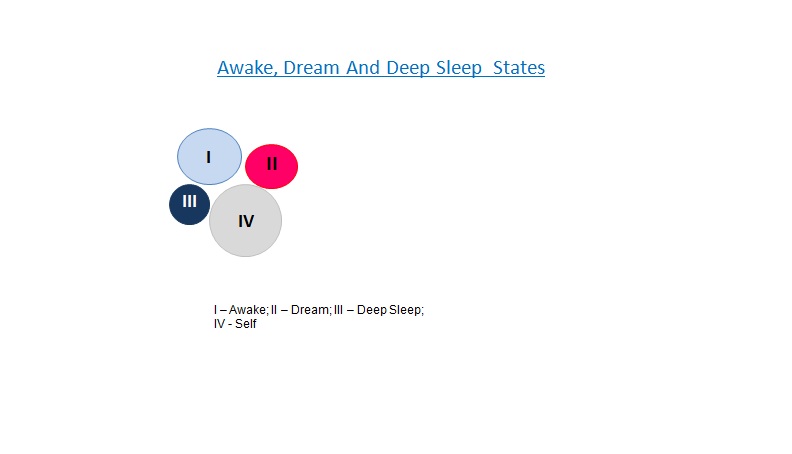
In my Talk on “Inquiry in Science and Vedanta “, the slides numbered 50 and 51 are about  the three states of  consciousness — Awake, Dream and Deep Sleep. (The full PowerPoint Presentation can be viewed at : http://beyond-advaita.blogspot.in/ ). The three worlds are represented by the three distinct circles I, II and III and a ‘Me’ is shown by the circle IV in the Slide 50 (Fig. 1 below). In our normal understanding, we think that “I am a separate ‘self’ (individual) and I pass through three distinct worlds viz. the Wakeful world, the Dream world and the Deep Sleep world.” We also take that the worlds to be external to ‘me.’

Fig 1: The Normal Worldview – an individual “I” (IV) passes through three distinct worlds (I, II, III) that are external to ‘me’ during a day of 24 hrs.

Continue reading

Incomplete Enlightenment – Q.333

Q: As I understand, the sense of “I” (distinguished from the ultimate I/Self)  is the source of “ignorance”. “Ignorance” leads to “the fear”, which inspires us to attempt to find “enlightenment”. The attempt to find “enlightenment” is the delusion that there is something to gain. The teachings tell us that “enlightenment” is the nature of existence. What needs to happen is the destruction/removal of ignorance, rather than the acquisition of anything. I already feel as if I have approached the “screen” upon which phenomenon occurs. By practicing “neti neti”, I attempt to see what always is, which is a temporary attempt to disregard things that can be seen. Once this happens, there is the inference of blankness/darkness/all-inclusiveness/voidness. And once this practice of “neti neti” is over, I begin to see things come of themselves, from little sparks … flakes of concepts … to their blooming as a climax of a concept. The climax wanes and the concept disappears of itself just as it arose.

A short time after this attempt at enquiry, the ease I had with reality fades. The sense that reality is not okay begins to gradually return. It feels as if I missed something from this experience. At other times, I feel as if perhaps this effort is part of the problem. Maybe the enquiry is meant to be a last ditch attempt to notice the fallacy of trying to do something, or even the attempt to try to do nothing.

 Is this the realization? That effort is resistance? That surrender to this fact is the ultimate motion?

 How does it happen that one can know “in the mind” that one is free, and yet continue to fall back into the conundrum of no longer feeling this freedom? Moments of complete freedom … knowing that it’s not my business to “do” life, not even to attempt to not “do” life … and yet slowly fall back into the habit? Continue reading