The brihadAraNyaka Upanishad says:
यदा सर्वे प्रमुच्यन्ते कामा येऽस्य हृदि श्रिताः । अथ मर्त्योऽमृतो भवत्यत्र ब्रह्म समश्नुत इति । — 4.4.7, brihadAraNyaka.
Meaning: When all the desires that dwell in his heart (mind) are gone, then he, having been mortal, becomes immortal, and attains brahman in this very body. (Translation: Swami Madhavananada.]
Shankara clarifies at this mantra that “It is virtually implied that desires concerning things other than the Self fall under the category of ignorance, and are but forms of death. Therefore, on the cessation of death, the man of realization becomes immortal. And attains brahman, the identity with brahman, i.e. liberation, living in this very body. Hence liberation does not require such things as going to some other place.” (Translation: Swami Madhavananada.]
Further, Shankara observes at 4.4.6, brihadAraNaka that “Therefore, as we have also said, the cessation of ignorance alone is commonly called liberation, like the disappearance of the snake, for instance, from the rope when the erroneous notion about its existence has been dispelled.” Continue reading
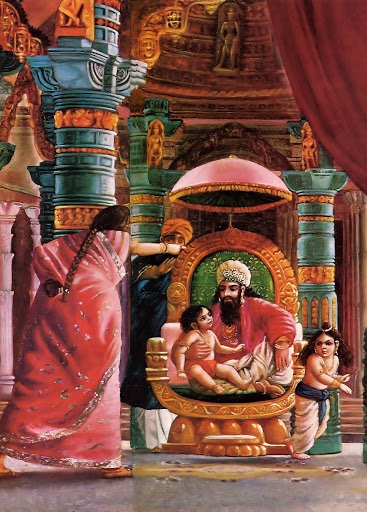 Dhruva was an adorable little boy. He saw his half-brother, Uttama, sitting and playing on the lap of their father, King Uttanapada. He too desired to climb on to the lap of Uttanapada. But his step-mother could hardly tolerate that. She gave a tight slap to him declaring that he was unfit to sit on the lap of the King as he was not born to her but to another queen. Crest-fallen and deeply hurt, the little kid, with his eyes full of tears, ran to his mother. His mother, a highly noble lady, consoled him and advised that he should achieve something so that people look at him with awe. The little Dhruva left the royal palace and went away to a distant forest. He met with a group of Sages in the forest and narrated to them his soulful story. They advised him to meditate on Vishnu. So, he embarked on a very austere and rigorous course of meditation. Regretting heavily the developments, the King and all his retinue, his mother, the queen and all his family implored that he should give up his askesis and return home. The King was even ready to abdicate the throne and promised to coronate him. But Dhruva was unrelenting. He did not succumb to the temptations and was uncompromising in his resolve. He pursued his meditation with greater vigor. He meditated on Vishnu, the Ultimate.